For about seventy years, from 1830, clipper ships were the racehorses of the sea. Sail has given way to steam and all the technological enhancements that have followed, but there is nothing at all more glorious than the sight of one of these magnificent vessels in full sail upon a shining ocean.
Thursday, 20 August 2009
Just give me a ship; a tall, tall ship, and a star to steer her by.
For about seventy years, from 1830, clipper ships were the racehorses of the sea. Sail has given way to steam and all the technological enhancements that have followed, but there is nothing at all more glorious than the sight of one of these magnificent vessels in full sail upon a shining ocean.
Wednesday, 24 June 2009
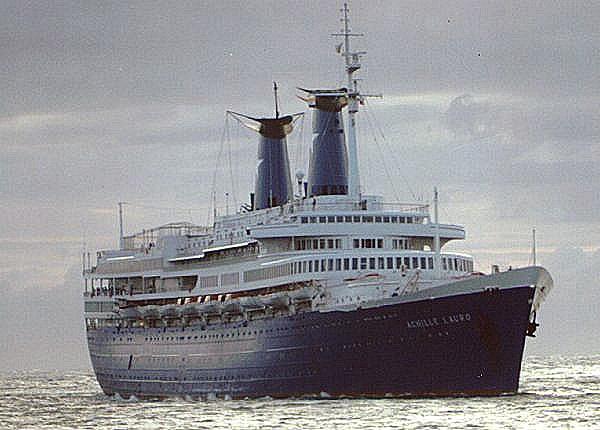
Fire at Sea. The sinking of Achille Lauro
In 1964, she was sold to the Flotta Lauro Line, or Star Lauro, (now MSC Cruises) and renamed the Achille Lauro (after the company owner). Extensively rebuilt and modernized after an August 1965 onboard explosion, the Achille Lauro entered service in 1966 carrying passengers to Sydney, Australia. The ship played a role in evacuating the families of British servicemen caught up in the Six Day War, arriving in Cairo on June 1, 1967.
The Achille Lauro was converted to a cruise ship in early 1972, during which time she suffered a disastrous fire. A 1975 collision with the cargo ship Youseff resulted in the sinking of the latter, and another onboard fire in 1981 took her out of service for a time. She was laid up in Tenerife when the Lauro Lines went bankrupt in 1982. The Chandris Line took possession of her in 1985, shortly before the hijacking.
1985 hijacking
On October 7, 1985, four men representing the Palestine Liberation Front (PLF) took control of the liner off Egypt as she was sailing from Alexandria to Port Said.
The hijackers had been surprised by a crew member and acted prematurely. Holding the passengers and crew hostage, they directed the vessel to sail to Tartus, Syria, and demanded the release of 50 Palestinians then in Israeli prisons. After being refused permission to dock at Tartus, the hijackers murdered wheelchair-bound American passenger Leon Klinghoffer and threw his body overboard. The ship headed back towards Port Said, and after two days of negotiations, the hijackers agreed to abandon the liner in exchange for safe conduct and were flown towards Tunisia aboard an Egyptian commercial airliner.
United States President Ronald Reagan ordered that the plane be intercepted by F-14A Tomcats from the VF-74 "BeDevilers" and the VF-103 "Sluggers" of Airwing 17, based on the aircraft carrier USS Saratoga, on October 10 and directed to land at Naval Air Station Sigonella, a N.A.T.O. base in Sicily, where the hijackers were arrested by the Italians after a disagreement between American and Italian authorities.
The other passengers on the plane (possibly including the hijackers' leader, Abu Abbas) were allowed to continue on to their destination, despite protests by the United States. Egypt demanded an apology from the U.S. for forcing the airplane off course.
Disagreement between Italy and U.S.
Italian Prime Minister Bettino Craxi claimed Italian territorial rights over the NATO base and Italian Air Force and Carabinieri lined up facing the American Navy SEALs which had arrived with two C-141's. Other Carabinieri were sent from Catania to reinforce the Italians. It was the gravest diplomatic crisis between Italy and United States and was resolved five hours later.
The ship continued in service; she was reflagged in 1987 when the Lauro Line was taken over by the Mediterranean Shipping Company to become StarLauro. On November 30, 1994, she caught fire off the coast of Somalia while enroute to South Africa. Abandoned, the vessel sank on December 2.
Click here for a brief video of the shocking fire that sank the Lauro.
Tuesday, 19 May 2009
The sinking of the Empress of Canada.
RMS Empress of Canada was an ocean liner built in 1920 for the Canadian Pacific Steamships (CP) by Fairfield Shipbuilding & Engineering Company at Govan on the Clyde in Scotland. This ship -- the first of two CP vessels to be named Empress of Canada -- regularly traversed the trans-Pacific route between the west coast of Canada and the Far East until 1939. This Empress was distinguished by the Royal Mail Ship (RMS) prefix in front of her name while in commercial service with Canadian Pacific. When not carrying mail, the ship would have been identified as SS Empress of Canada.
In 1920, Canadian Pacific Steamships ordered a new ship to be built by Fairfield Shipbuilding & Engineering Company at Govan near Glasgow in Scotland. This Empress was a 21,517 ton, 653 foot ocean liner. She undertook her maiden voyage on 5 May 1922. Based at the port of Vancouver, British Columbia, the first Empress of Canada was intended to provided service to Japan, Hong Kong, and China. Her sister ships included Empress of France and Empress of Britain.
Great Kantō earthquake
On 34 September 1923, the Empress of Canada arrived at Tokyo harbor -- just three days after the devastating Great Kantō Earthquake struck the city. She found that the Empress of Australia had been converted to a command post from which the British consul was directing relief work; and the Empress of Canada transported refugees to Kobe -- 587 Europeans, 31 Japanese, and 362 Chinese.
World War II
Following the outbreak of World War II in 1939, she was converted for use as a troopship. She carried ANZAC troops from New Zealand and from Australia to the war zones in Europe.
SS Empress of Australia's ballroom was cleared for sleeping as ANZAC troops are transported from the Antipodes to the war zones in the Northern Hemisphere. This specific image was captured at sea in January 1940 near Fremantle, Western Australia.
The return voyage from Europe was not less dangerous than the trip north had been. On 13 March 1943, while en route from Durban, South Africa to Takoradi carrying Italian prisoners of war along with Polish and Greek refugees, the SS Empress of Canada was torpedoed and sunk by the Italian submarine Leonardo Da Vinci approximately 400 miles (640 km) south of Cape Palmas off the coast of Africa. Of the approximate 1800 people on board, 392 died. Nearly half of the fatalities reported were Italian prisoners.
Monday, 18 May 2009
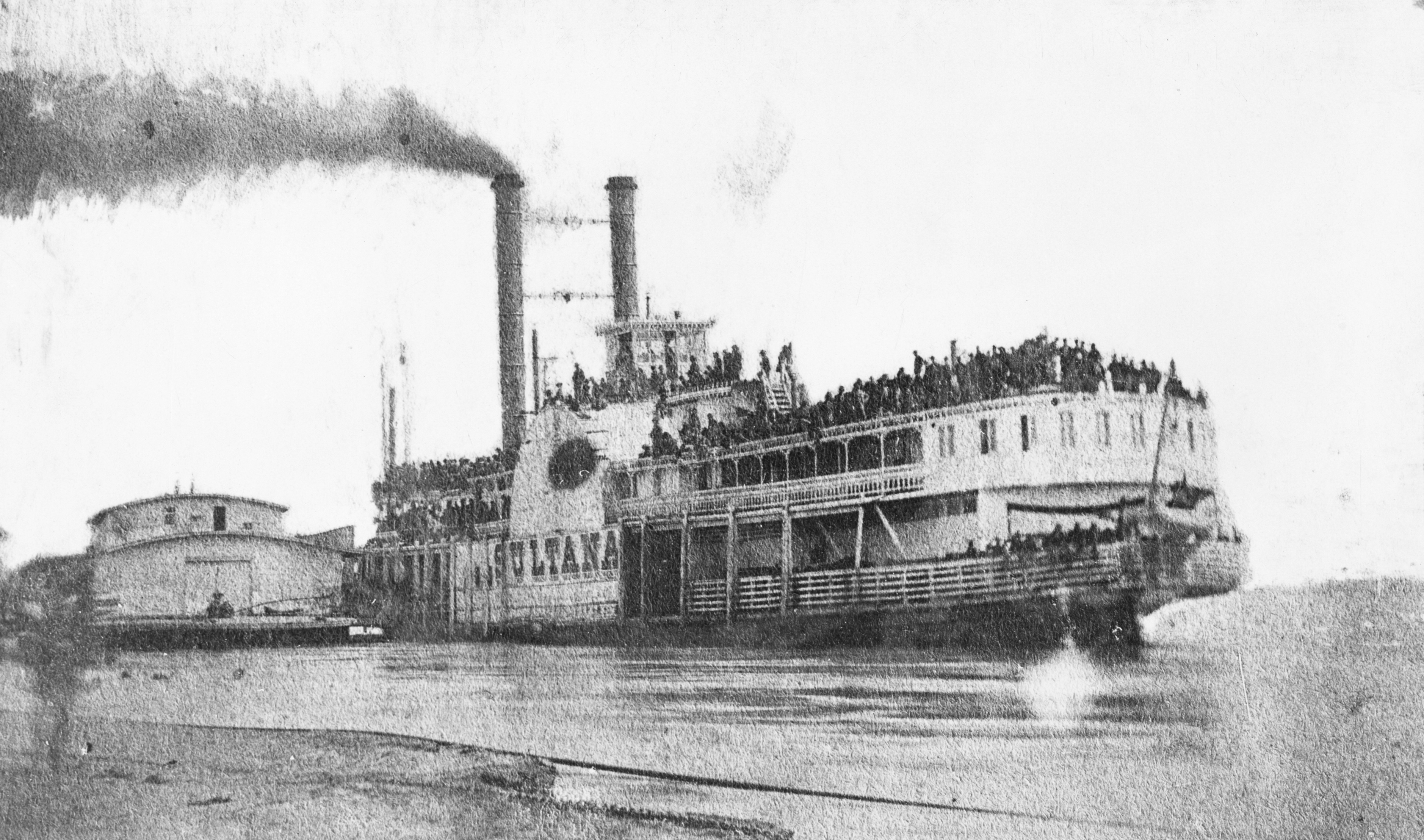
Fire on the River. The Steamboat SS Sutlana
The steamboat Sultana was a Mississippi River paddlewheeler destroyed in an explosion on 27 April 1865. This resulted in the greatest maritime disaster in United States history until that time. An estimated 1,800 of the 2,400 passengers were killed when one of the ship's four boilers exploded and the Sultana sank not far from Memphis, Tennessee. This disaster received somewhat diminished attention as it took place soon after the assassination of President Abraham Lincoln and during the closing weeks of the Civil War.
Under the command of Captain J.C. Mason of St. Louis, the Sultana left New Orleans on April 21, 1865, with 75 to 100 cabin passengers, deck passengers, and numerous heads of livestock bound for market in St. Louis. At Vicksburg, Mississippi, the steamship stopped for a series of hasty repairs to the boilers and to take on more passengers. Rather than have a bad boiler replaced, a small patch weld job was done to reinforce a leaking area. A section of bulged boiler plate was removed, and a patch of less thickness than the parent plate was riveted in its place.
This repair only took about a day, whereas to replace the boiler completely would have taken about three days. Captain Mason was itching to be on his way and had the patch job done because it was faster. During the Sultana's time in port, men tried to muscle, bribe, and threaten their way on board, until the ship was bursting at the seams with soldiers. More than two thousand men crowded aboard.
Most of the new passengers were Union soldiers, chiefly from Ohio and just released from Confederate prison camps such as Cahawba and Andersonville. The US government had contracted with the Sultana to transport these former prisoners of war back to their homes. With a legal capacity of only 376, the Sultana was severely overcrowded. Many of Sultana's passengers had been weakened by their incarceration and associated illnesses. Passengers were packed into every available berth, and the overflow was so severe that the decks were completely packed.
The cause of the explosion was a leaky and poorly repaired steam boiler. There was reason to believe allowable working steam pressure was exceeded attempting to overcome the spring river current. The boiler (or "boilers") gave way when the steamer was about 7 to 9 miles north of Memphis at 2:00 A.M. There was a terrific explosion that sent some of the passengers on deck into the water while destroying a good portion of the ship. Hot coals scattered by the explosion soon turned the remaining superstructure into an inferno, the glare of which could be seen in Memphis.
The first boat on the scene at about 3:00 A.M. (an hour after the explosion) was the southbound steamer Bostonia II which overtook the burning wreck and rescued scores of survivors. The hulk drifted to the west bank and sank about dawn off the tiny settlement of Mound City, Arkansas. Other vessels joined the rescue, including the steamer Arkansas, the Jenny Lind, the Essex, and the Navy sidewheel gunboat USS Tyler, manned by volunteers. The ship's regular crew had been discharged days before.
Passengers who survived the initial explosion had to risk their lives in the icy spring runoff of the Mississippi or burn with the ship. Many died of drowning or hypothermia. Some survivors were plucked from trees along the Arkansas shore. Bodies of victims continued to be found downriver for months, some as far as Vicksburg. Many bodies were never recovered. The Sultana's officers, including Captain Mason, were among those who perished.
About 500 survivors, many with horrible burns, were transported to hospitals in Memphis. Up to 300 of them died later from burns or exposure. Newspaper accounts indicate that the people of Memphis had sympathy for the victims despite the fact that they had recently been enemies. The Chicago Opera Troupe staged a benefit, the crew of the Essex raised $1,000, and the mayor took in three survivors.
Monuments and historical markers to the Sultana and its victims have been erected at Memphis, Tennessee; Muncie, Indiana; Marion, Arkansas; Vicksburg, Mississippi; Cincinnati, Ohio; Knoxville, Tennessee; Hillsdale, Michigan; and Mansfield, Ohio.
Saturday, 16 May 2009
The Pamyat Azova and a rotten egg.
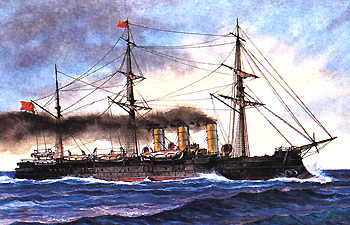
The Pamiat Azova (Память Азовa meaning Memory of Azov) was a unique armoured cruiser built for the Imperial Russian Navy in the late 1880s. She was decommissioned from front line service in 1909, converted into a depot ship and sunk by British torpedo boats during the British Campaign in the Baltic 1918-19, in the Russian Civil War.
The ship served with the Baltic Fleet and took part in a round the World Cruise with Crown Prince Nicholas on board. This led to a Fabergé egg, the Memory of Azov being made to commemorate this event. There was a mutiny aboard the cruiser in 1906 near Reval and the ship was placed in reserve. In 1909 she was converted into a torpedo boat depot ship and renamed Dvina. She was sunk by the British torpedo boat CMB79 in Kronstadt Harbour on 18 August 1919. The wreck was raised and scrapped.
The egg commemorates the voyage made by then-Tsarevitch Nicholas and Grand Duke George to the Far East in 1890.
The trip was made after a suggestion by their parents to broaden the outlook of the future Tsar and his brother. At the time, Grand Duke George was suffering from tuberculosis and the voyage only exacerbated it. Tsarevitch Nicholas was also the victim of an attempted assassination whilst in Japan and sustained a serious head wound. The Tsarina was presented with the egg before these events occurred and it was never one of her favourite eggs.
Monday, 13 April 2009
Remembering RMS TITANIC
It took 4000 proud Irish men to build her, and one fated Englishman to sink her.
The magnificent White Star Liner TITANIC sank on this day, ninety seven years ago. This blog is a testament to her enduring mystique in the collective mind of human kind ever since. For those who may be interested, kindly refer here to an astonishing interview with survivor Edith Russell, and if you listen closely, you will learn the reason for the decision to title my blog Nineteen Keys.
The Royal Mail Ship TITANIC sank on this day, 97 years ago.
Survivors, victims and statistics
Category, Number Aboard, Number of Survivors, Percentage That Survived, Number Lost, Percentage That Were Lost
First Class 329 199 60.5 % 130 39.5 %
Second Class 285 119 41.7 % 166 58.3 %
Third Class 710 174 24.5 % 536 75.5 %
Crew 899 214 23.8 % 685 76.2 %
Total 2,223 706 31.8 % 1,517 68.2 %
Saturday, 4 April 2009
U-Boat Ace Of The Deep! Kretchmer and U-99

The Brilliance of Otto Kretchmer.
In the U-Boat war in the Atlantic, there were only a handful of captains who were responsible for the sinking of over 150,000 tonnes of enemy shipping. Otto Kretchmer was chief among them all.
Commodore Otto Kretschmer (May 1, 1912 – August 5, 1998) was a German U-boat commander of the Second World War, and was the most successful Ace of the Deep. From September 1939 until being captured in March 1941, he sank 47 ships for a total of 274,333 tons. For this he received the Knights Cross with Oak Leaves and Swords, among other commendations. He earned the nickname "Silent Otto" both for his successful use of the "silent running" capability of the U-boats as well as for his reluctance to make radio broadcasts during patrols.
The German invasion of Poland found Kretschmer still in command of U-23, and he was soon sent into action along with the rest of the Kriegsmarine's U-Boat fleet. His first war patrols ranged across the North Sea and around the British coast. Kretschmer's first success came in Moray Firth where he attacked and sunk the Danish 10,517 ton tanker Danmark on January 12, 1940 using torpedoes. The British admiralty at that time thought that the tanker had struck a mine as they did not locate any U-boat in the area. A month later on 18 February, Kretschmer sank the 1,300 ton British fleet destroyer HMS Daring off the Pentland Firth while she was escorting convoy HN-12 from Norway. U-Boat crews almost always avoided deliberately engaging enemy destroyers, so the Daring's destruction was rightly seen as a very skillful attack by both Kretschmer and the U-23.
In April 1940, after eight patrols, Kretschmer left the U-23 and was transferred to the newly-completed Type VIIB U-99, and in a sense started his legacy. After two months' training and shakedown maneuvers in German waters, U-99 went into action in June 1940. During the first four patrols of the U-99, Kretschmer started attacking convoys at night on the surface, taking down merchant ships with highly accurate shots, using only one torpedo per target ship in order to save ammunition, and the quote "One torpedo ... one ship" is attributed to Kretschmer from around this time. Kretschmer's tactics were widely copied throughout the U-Boat force, although they achieved mixed results in practice.
His most successful patrol occurred in November-December 1940. During that patrol, Kretschmer and U-99 sank three British armed merchant cruisers, HMS Laurentic (18,724 tons), HMS Patroclus (11,314 tons) and HMS Forfar (16,402 tons). Laurentic and Patroclus were sunk on the night of 3-4 November after they responded to distress calls from the 5,376 ton British freighter Casanare, which U-99 had mortally wounded about 250 miles west of Ireland. Forfar was sunk a month later on 2 December while steaming to join up with and escort outbound convoy OB-251. Put together, the three AMCs totalled over 46,000 gross tons. These three successes earned Kretschmer the number-one spot on the Aces list, and was never surpassed. Klaus Bargsten served aboard U-99 under Kretschmer, before being promoted to captain himself and becoming the sole survivor of U-521 on June 2, 1942.
Kretschmer was also meticulous in his conduct towards the crews of torpedoed ships. When attacking lone merchant ships in the days before wolfpack tactics began in earnest, he had been known to hand down bottles of spirits and blankets into lifeboats and give them the course to the nearest land. On one patrol in September 1940, Kretschmer had also retrieved a survivor of another torpedo attack who was alone in the Atlantic on a small raft and took him aboard, transferring him later to a lifeboat after his next successful attack.
On his last patrol in March 1941, he sank 10 more ships, but these were to be Kretschmer's last victims. On March 17 1941, during a counterattack by British escorts of Convoy HX-112, U-99 was disabled after repeated depth charge attacks by the British destroyers HMS Walker and HMS Vanoc. Kretschmer surfaced and, under fire from the British vessels, scuttled his boat. Three of his men were lost, but Kretschmer and the remainder of U-99's crew were captured by the British. The same day saw the British escorts scored another success against the Kriegsmarine: another noted U-Boat skipper, Joachim Schepke, was killed aboard U-100 when that boat was rammed and sunk in heavy fog by Vanoc.
Kretschmer's usual standards of conduct were evident during the sinking of his boat; he signaled HMS Walker asking for rescue for his men, took pains to ensure as many left the submarine as possible, and assisted some of his crew towards the rescue nets hung from the British destroyer. Kretschmer's strength was evidently failing in the cold water and his own rescue was at the hands of a British sailor who climbed down the nets and plucked him from the water, in a gesture characteristic of the excellence and finest qualities of the Royal Navy.
Subscribe to:
Posts (Atom)