Showing posts with label Queen Mary. Show all posts

Friday, 30 May 2008

Farewell to a Cunard Queen.


The advent of the jet aircraft was the death knell of the great liners and Cunard, committed to the construction of Queen Mary's replacement, the QE2, needed to sell the old Queen to pay the bills. Very narrowly, Queen Mary 2 was sold to Longbeach California where she lies in state to this day as an hotel and tourist attraction, having very nearly been sold to Japanese scrap merchants.


Ship have a strange effect of those of us who love them. I'm sure that I'm not alone in being moved by a long blast from a ship's whistle. The only time our present Monarch, Queen Elizabeth 2nd has cried in public, was at the farewell of her beloved yacht Britannia. Ships are far, far more than the sum of their parts, they carry with them the spirits of all those who travelled in them and few ships have the service record of the mighty Queen Mary.

After 1001 crossings of the Atlantic, she sailed on her final journey, from Southampton to Longbeach. So much history, so much tradition, it is hard to imagine a ship more reflective of the true magnificence of the great ocean liners than is Queen Mary. The ocean she spanned with safety and distinction for so many years is still the most important bridge in humanity, that between the United States and Europe, connecting the new world with the old, and although the bulk of traffic these days flies over the ocean rather than upon it, an important, industry changing decision was made by Cunard on June 7th, 1998, which not only refreshed the memory of this mighty Cunard Queen, but announced the birth of a new and exciting Cunader bearing her famous Royal name, opening the seas to a new generation and enabling thousands, once more, to cross the Atlantic in comfort, in safety and in style.

Farewell to the Royal Mail Steamer, QUEEN MARY. Long upon the sea, longer upon the memory. Longest in the heart.

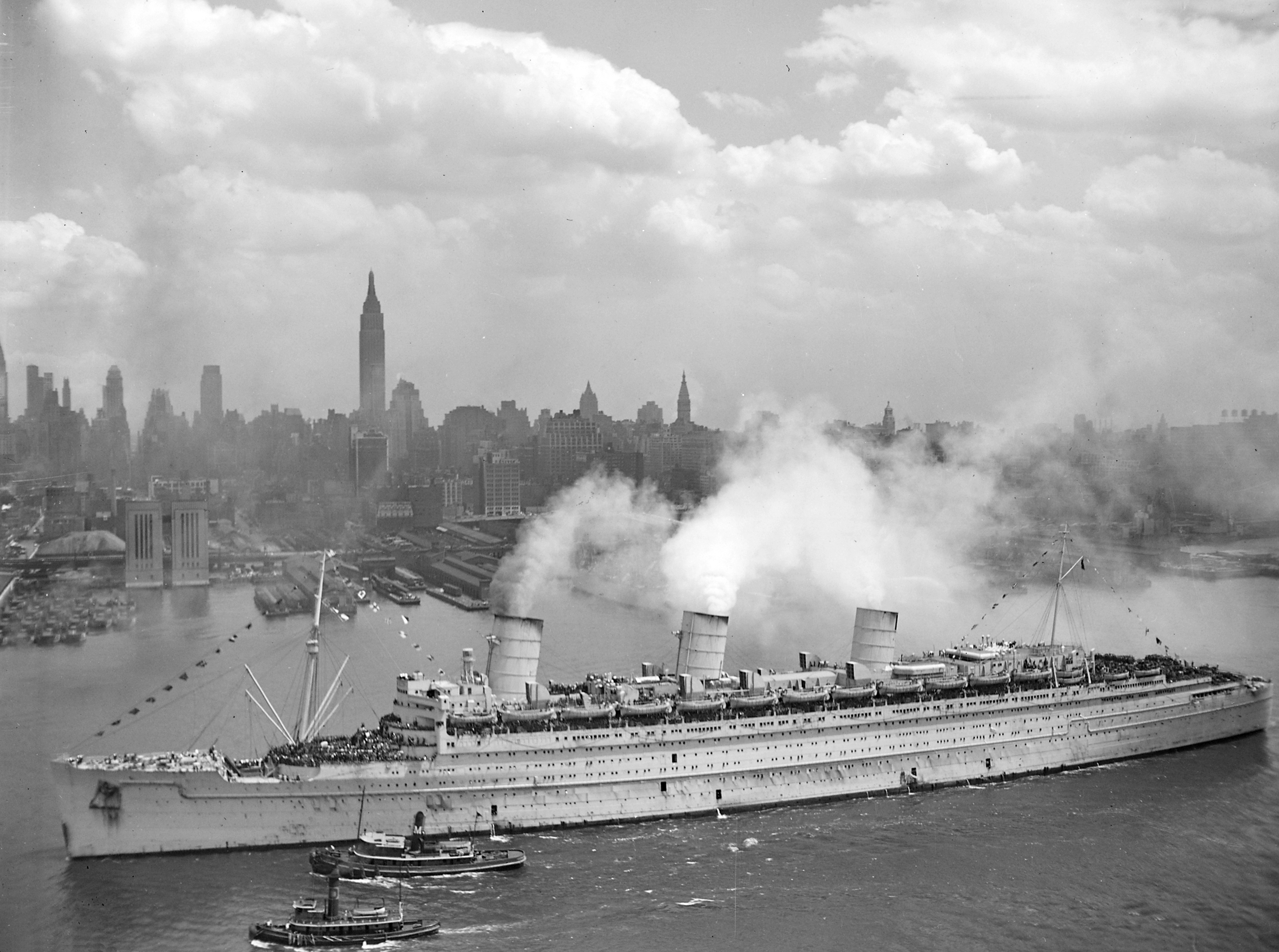
War Service of "The Silver Ghost".


In late August 1939, the Queen Mary was on a return run from New York to Southampton. However, the international situation led to her being escorted by the battlecruiser HMS Hood. She arrived safely, and set out again for New York on 1 September. By the time she arrived, the Second World War had started and she was ordered to remain in post until further notice alongside the Normandie. In 1940 the Queen Mary and the Normandie were joined in New York by Queen Mary's new running mate Queen Elizabeth fresh from her secret dash from the Clydebank. The three largest liners in the world sat idle for some time until the Allied commanders decided that all three ships could be used as troopships (unfortunately, the Normandie would be destroyed by fire during her troopship conversion).

The Queen Mary left New York for Sydney, where she, along with several other liners, was converted into a troopship to carry Australian and New Zealand soldiers to the United Kingdom. Eventually joined by the Queen Elizabeth, they were the largest and fastest troopships involved in the war, often carrying as many as 15,000 men in a single voyage, and often travelling out of convoy and without escort. During this period, because of their wartime grey camouflage livery and elusiveness, both Queens received the nickname "The Grey Ghost". Their high speed meant that it was virtually impossible for U-Boats to catch them. Once, Germany was nearly successful; whilst the Queen Mary was in South American waters, a radio signal was intercepted which indicated that spies had reported her last refuelling stop and a U-Boat was waiting on her line of voyage. After being alerted, the Queen Mary changed course and escaped.

On 2 October 1942, Queen Mary accidentally sank one of her escorts, slicing through the light cruiser HMS Curacoa off the Irish coast, with the loss of 338 lives. Due to the constant danger of being attacked by U-Boats, on board the Queen Mary Captain C. Gordon Illinsworth was under strict orders not to stop for any reason, the Royal Navy destroyers accompanying the Queen were ordered to reverse course and rescue any survivors.


In December 1942, the Queen Mary was carrying exactly 16,082 American troops from New York to Great Britain, a standing record for the most passengers ever transported on one vessel. While 700 miles from Scotland during a gale, she was suddenly hit broadside by a rogue wave that reached a height of 28 metres (92 ft). An account of this crossing can be found in Walter Ford Carter's book, No Greater Sacrifice, No Greater Love. Carter's father, Dr. Norval Carter, part of the 110th Station Hospital on board at the time, wrote that at one point the Queen Mary "damned near capsized... One moment the top deck was at its usual height and then, swoom! Down, over, and forward she would pitch." The incident inspired Paul Gallico to write his story, The Poseidon Adventure, which was later made into a film by the same name, using the Queen Mary as a stand-in for the SS Poseidon.

During the war, the Queen Mary carried British Prime Minister Winston Churchill across the Atlantic for meetings with fellow Allied forces officials, he would be listed on the passenger manifest as "Colonel Warden" and insisted that the lifeboat assigned to him had a .303 machine gun fitted to it so he could "resist capture at all costs".

Wednesday, 28 May 2008

The birth of a Cunard Queen.


In the 1930's, the race was on. The greatest transportation route on earth was between the United States and Europe, as indeed it is today. There was great competition between Germany and especially between France and Britain. The British entry into to fray was the magnificent Cunard-White Star liner, Queen Mary, although she was very nearly named Victoria.

Until her launch she was known simply as Cunard hull No. 534, since the name she was to be given was kept a closely guarded secret. Legend has it that Cunard intended to name the ship "Victoria", in keeping with company tradition of giving its ships names ending in "ia". However, when company representatives asked the King's permission to name the ocean liner after Britain's "greatest queen", he said his wife, Queen Mary, would be delighted. And so, the legend goes, the delegation had of course no other choice but to report that No. 534 would be called RMS Queen Mary. However, this story was denied by company officials, and is probably apocryphal, since traditionally the names of sovereigns have only been used for capital ships of the Royal Navy. It is more likely that the name Queen Mary was decided on as a compromise between Cunard and the White Star Line, with which Cunard had recently merged, who had a tradition of using names ending in "ic".

Construction began in December 1930 on the River Clyde by the John Brown & Company Shipbuilding and Engineering shipyard at Clydebank Scotland but was halted in December 1931 due to the Great Depression. Cunard applied to the British Government for a loan to complete 534. The loan was granted, with enough money to complete the Queen Mary as well as enough to build a running mate, hull No. 552 which became Queen Elizabeth. One condition of the loan was that Cunard merge with the financially ailing White Star Line, which was Cunard's chief British rival at the time. Both lines agreed and the merger was completed in April 1934. Work on the Queen Mary resumed immediately and she was launched on 26 September 1934. It had taken 3½ years and cost 3½ million British Pounds to complete her.

Tuesday, 27 May 2008

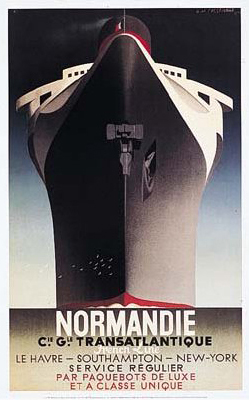
SS NORMANDIE and the Atlantic Blue Riband Prize.


Between the wars, a magnificent contest developed between those most intractable of adversaries, Great Britain and France, for the coveted Blue Riband, the prize awarded to the fastest crossing of the North Atlantic by steamship. An invention of the 1860's, the Blue Riband was a pennant awarded to the fastest ship crossing the Atlantic and was flown from the highest mast to signify the honour. In 1935, the pennant was replaced by the Hale Trophy, but the title 'Blue Riband' remained. There were prizes for both directions of Atlantic crossing and the greatest contest was observed between the wars, as business between Europe and America became increasingly interdependent and time was, more and more, of the essence.


One of the two great combatants in this battle Royal was the SS Normandie, a gorgeous ship by any measure. Launched in 1932, she was a wonder to behold. There were many tremendous developments in the 1930's in the world of trans-Atlantic shipping, chief among them being the merger between the ailing White Star Line with Cunard Line, to become, briefly, Cunard-White Star and finally, Cunard as the line is known to this day. The chief designer of the Normandie, Vladimir Yourkevitch had initially approached the Cunard-White Star with proposed designs for their hull number 534, soon to be the renowned 'Queen Mary', much, much more about which later, but was rejected as the plans represented too radical a break from tradition for the British shipping company.

The French Line Compagnie Générale Transatlantique, or CGT, adopted Yourkevitch's designs and commissioned the new hull to be built at France's premier shipyard, the Penhoët shipbuilders at St. Nazair. The new ship would draw talent from the finest designers, architects, and artisans of France. Yourkevitch's designs would allow the ship to match the great speed of Britain's 'Queen Mary' with one-fifth less horsepower and substantial fuel savings, and allow the Normandie to be the first French Liner ever to be in competition for the cherished 'Blue Riband'. When she won it in 1935, the Normandie wore an enormous blue pennant, over thirty feet long from her foremast. Officers still insist she ran faster whilst wearing her pennant!

The NORMANDIE won the Blue Riband in 1935 and would lose it each subsequent year to Queen Mary until the outbreak of World War Two. The competition between these two leviathans of the deep was legendary and the awarding of the Blue Riband in the second half of the 1930's was only ever a mater of one or two knots.

In February 1942, though, after the Normandie had been seized by the US military and was being converted into a troop ship under the new name of USS LaFayette, a dreadful fire broke out from welding sparks and the huge liner capsized at her dock after uneven flooding caused by water used to fight the fire. Old sailors will tell you that you should never, EVER, change the keel name of a ship, or the one she is named with at construction. To do so is to temp the Fates, and so it was to be with the beautiful, glorious, wonderful, magnificent SS NORMANDIE.