Sunday, 18 April 2010

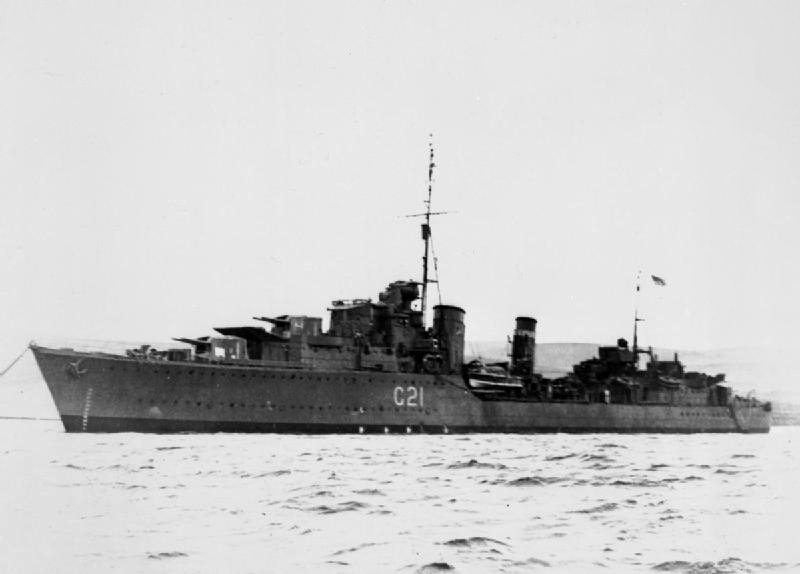
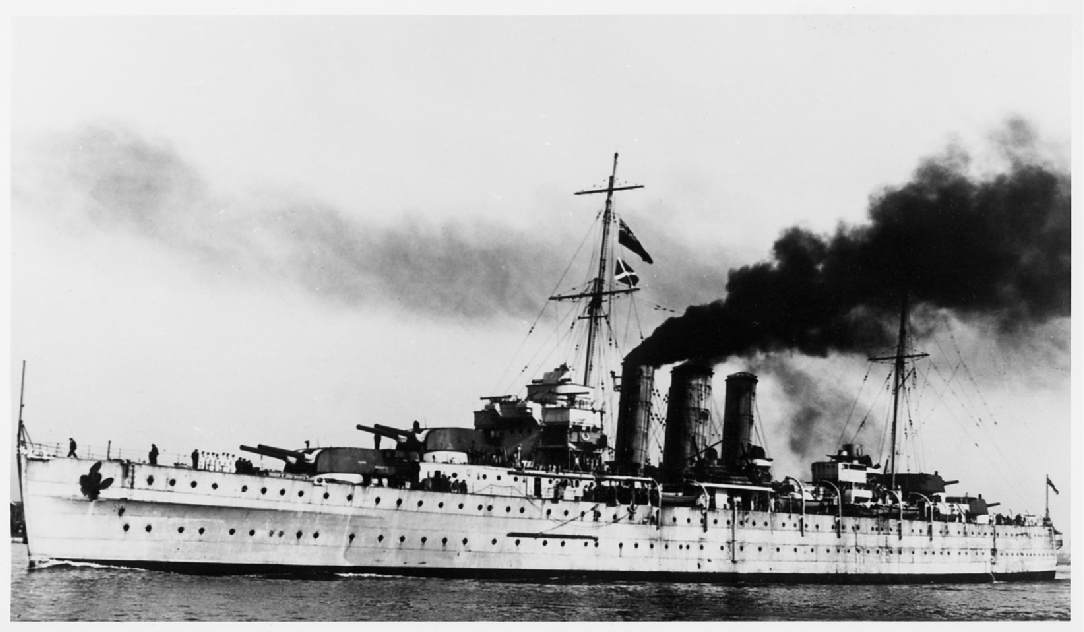
HMS Dorsetshire, the Bismarck and the truth about Captain Benjamin Martin, Royal Navy.


In May of 2008, I authored a post entitled "HMS Dorsetshire and the ignominy of Benjamin Martin". By clicking the underlined titled of that post you will be taken to what I wrote then.

In that post, I postulated the view that Captain Martin conducted himself in a less than honourable way in leaving so many survivors of the Bismarck to their fate in the Atlantic on that afternoon in late May, 1941. I offered in support of this theory the fact that Captain Martin was relieved of his command upon HMS Dorsetshire's arrival in Newcastle following the dispersal of the fleet returning from battle.

I further offered the colloquial information gathered about Midshipman Joe Brooks and his brutal treatment for attempting to assist Bismarck survivors. Finally, I suggested that Captain Martin's command style was brutal, even cruel on occasion, and suggested his command style was contributory to suicides by crew members in Dorsetshire during her convoy duties that preceded her joining the battle to sink the Bismarck.

That post, more than any other, has generated a polarised discussion in the comments section. It is reproduced for you at the end of this post. Let me conclude, for now, with my words from the end of the most recent comment. I'm hoping they will solicit a return visit here, one month from now.

One month from tomorrow, May 27th, 2010, marks the 69th anniversary of the sinking of the KMS Bismarck by an attack force of His Majesty’s Royal Navy. On that day, I shall publish a post here on my blog that lays bare the entire truth as I have learned it to be.

I am now certain that many of my previously held beliefs are wrong. I will explain myself more fully on May 27th, 2010 here with a brand new post on the subject.


Thank you all, so very kindly, for your continuing interest and for visiting "Nineteen Keys and the Lure of a Furious Sea". It will be an honour, and indeed my duty, to present for you all, my findings in a month and a day from today.

Best wishes until then.


Every Sailor


Anonymous said...

My father was an officer on the Dorsetshire and present when Martin announced he was going after the Bismarck. According to my father, Martin had received no order to go after Bismarck and therefore abandoned his convoy. That is the reason for him being relieved of his functions afterwards.
21 September 2008 17:53

Every Sailor said...

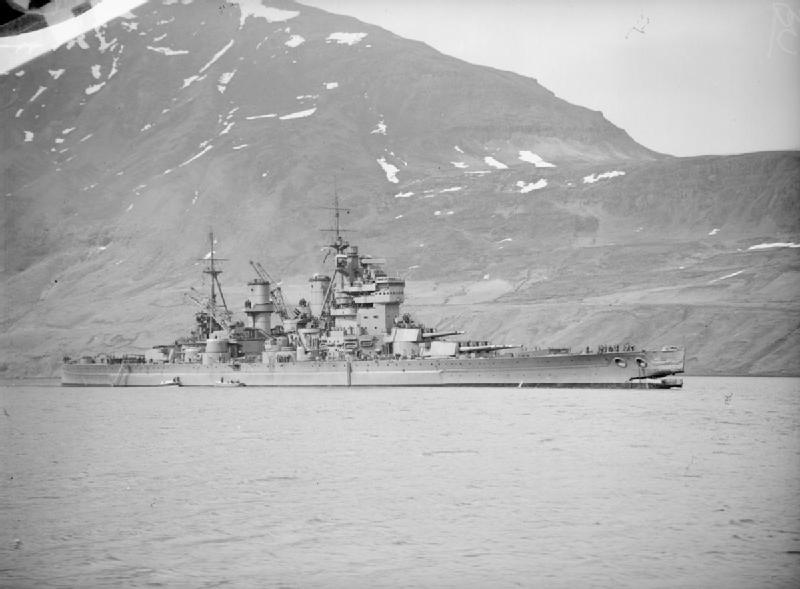
Hello Anonymous, and thank you very much indeed for your comment. I'm afraid, with every respect, that your Father is mistaken. Admiral Sir John Tovey flew his flag in HMS King George V, which was the flagship involved in the pursuit of Bismarck following the Battle of the Denmark Strait which culminated in the tragic loss of HMS Hood. After it was clear Bismarck was done for, Admiral Tovey ordered HMS Dorsetshire, under the command of Captain Benjamin Martin, Royal Navy, to finish her off with torpedoes. This done, his further orders were to recover Bismarck survivors. KGV was very low on fuel and needed to recover to Scapa Flow and left Dorsetshire on scene to carry out these orders. However, Captain Martin used the pretext of U-boats in the area to leave hundreds and hundreds of fellow sailors in the Altantic to die, no doubt informed by the still recent memory of the loss of HMS Hood. His disgraceful actions resulted in him losing his command on arrival in Newcastle days later, and not for the reasons your Father suggests. With best regards, and thanks again for your visit.
21 September 2008 18:13

Anonymous said...

I think we are both right. Dorsetshire was never ordered to leave her convoy and went off to the scene to join the fight without permission. She was then ordered to finish Bismarck off. My father was present when Martin made the decision to abandon his convoy. That is historical fact. I don't think he was relieved of his functions for leaving the survivors in the water, that must be pure speculation, unless you have documented proof.

I'm fascinated by the character of Joe Brooks. Have you got anything on him? It was my father who took him the news that he was accused of leaving the ship without permission. He just said, "Jesus". I know he left the Dorsetshire before she was sunk.

I don't want to sign up on Google. My name is Martin. I live just across the Rhine from you in Alsace.
2 October 2008 14:43

Anonymous said...

Thanks for removing the comment. I'm not condoning Martin's actions. He was a hothead and probably a lot more... All reports I have read back up the story of a submarine alert and he was only following procedure. He may well have been looking for a way to curtail his rescue mission. There was a U-Boot (U27?)somewhere near, but it had no more torpedoes. To give Martin credit, he gave the Bismarck sailors who died on Dorsetshire a full military funeral and allowed fellow sailors to make the Hitler salute.

We cannot place ourselves in the context of war. The Doresthire survivors were machine gunned in the water by the very Japanese planes that had sunk the ship. That is also against all the rules of war. It's too easy to condemn people retrospectively. You can even excuse Martin for abandoning his convoy to go and get a bit of action, the number of suicides on Dorsetshire during convoy patrol indicating the desperation caused by the boredom of nothing happening and the constant fear that a torpedo would send you to the bottom in a few minutes.

Let not our fascination for the War blind us into glorifying it.
12 October 2008 16:02

Every Sailor said...

Hello Martin, thanks again for your visits. I haven't removed any comment from this entry and don't know to what you refer. In the time since last writing I was waiting for academic friends to get back to me to confirm my understanding of Captain Martin's motivation and the real reasons for his removal from the command of HMS Dorsetshire, but to date I have no further information, nor do I have any further details of the career of Mid Brooks, although he was received as guest of honour at many Bismarck survivor reunions until well into the 70's. With respect, I think you're wide of the mark in accusing this site of glorifying war. I take the view that war is the apotheosis of vulgarity, hardly glorious, merely an often revisited reminder of our history as savages. My interest here is in ships, and the men who go down to the sea in them. All the very best, Martin, and thanks again for visiting.
12 October 2008 23:27

Anonymous said...

Sorry if I went a bit overboard (sorry about the pun) on my last comment about glorifying the war.
And I could have sworn there was a comment about Martin losing his command for leaving the Bismarck survivors in the water. My mistake. I was not accusing your site of doing anything of the sort. There is just a danger of getting out of touch with the reality. Lots of Brits are fascinated by the War. They tend to get disconnected from the horrors of war.
I'm waiting with baited breath for the information about Martin from your historian friends. I'm also sure Martin used the sub alert to get his revenge on the Bismarck sailors. But is there any historical proof? My father had a few brushes with him. Once my father's Walrus (he was the "observer" (navigator))was left in the middle of the ocean by Martin who suddenly decided to go and look at something. Luckily my father's training taught them to do square searches and he eventually found the ship. My father nearly got into deep trouble when he went at Martin for leaving the agreed position for pick-up.

You can look at my site. Sorry, there's nothing about Dorsetshire.
www.mollkirch.com

Greetings, Martin
13 October 2008 11:29

Anonymous said...

I am reading Robert Ballard's book about the Bismarck and just got through with the section about Martin's decision to leave the German survivors scraping at the sides of the Dorsetshire as it sailed away. Surely he didn't believe a German submarine would launch a torpedo at a ship rescuing it's own countrymen. I believe Martin should go to hell for leaving those men to die.
10 November 2008 06:05

Every Sailor said...

Hello anonymous, and thank you for your comment. I agree with you that Captain Martin's decision to leave all those hundreds of Bismarck survivors in the water is difficult to fathom. The impression I have formed of him is that he was, to put it mildly, a difficult man. It should be remembered that the sinking of HMS Hood only days earlier would have been fresh in his mind, though, and so perhaps he abandoned these men to the Atlantic as an act of revenge. No U-Boat ever fired upon a ship recovering survivors. What is certain, though, is that he was relieved of his command upon arrival at Newcastle days later. It is interesting to imagine what was going through the collective mind of HMS Dorsetshire's ship's company when she herself was sunk by the Japanese the following year, with hundreds of sailors spending the night in the water before being rescued!
10 November 2008 13:16

Anonymous said...

My last comment doesn't seem to have appeared on your site. Are you running out of space? I found this link which mentions the presence of U74 during the sinking of the Bismarck. So there was a U-Boot in the area.

http://www.uboat.net/articles/index.html?article=25

Greetings, Martin
10 January 2009 13:13

Anonymous said...

It's my again, Martin.

This video talks about Dorsetshire leaving its convoy "on its own initiative", in other words "abandoning it".

http://www.youtube.com/watch?v=WubneHZBeic&NR=1

Most likely the reason for Martin's loss of command.
11 January 2009 19:54

Every Sailor said...

Hi Martin, this is your characterization, unsupported by the evidence. Leaving convoy duty in support of a larger action is within the purview of any warship captain in time of war unless he has explicit orders to the contrary. Your use of the words "abandoning it" are emotive, and using them to support what amounts to nothing more than your opinion is not valid. Your long post of some time ago was deleted because it rehashed your points of view made clearly in earlier entries. You're entitled to your opinions, Martin, but I reserve the right to remove them from my blog when, in my view, they offer nothing in pursuit of the truth. Once again, I put it to you that Captain Martin of HMS Dorsetshire was relieved of his command on arrival in Newcastle due, in part, to his dereliction of duty in abandoning (to borrow your word) Bismarck survivors to drown in the north Atlantic, when given explicit orders by Admiral Tovey embarked in HMS King George V to pick them up. If you have evidence to the contrary, I'd be glad to have it.
11 January 2009 20:51

Anonymous said...

Hello Every Sailor and Martin.
I have come across this sit by pure accident and find it quit disturbing. I am the great grandchild of Benjamin Martin, and a serving member of the Royal Navy. I Find this blog very one sided on behalf of yourself Every Sailor and find you do not seem to give credit to Martins opinion.

I am sure there is some form of evidence that reflects both your arguments and mine, though it will be one of those things that will never come to light but just think of these true facts that still ring true to this very day. Leaving your patrol (Convoy) is an act of “abandoning” and is an act that is punishable. At war the ship is first and life is second. Ask yourself this, if you were in the situation my great granddad found himself in, sitting in the water like a sitting duck with a possible U –Boat in the area. Would you not remove yourself to save your ship and the ships company? Or would you stay and risk your men and the fellow men they saved.

Every Sailor you say “No U-Boat ever fired upon a ship recovering survivors” but no one ever sank the Germans pride battle ship the Bismarck. War is a very unpredictable thing. I believe you should watch the link Martin put on your blog as this is view from both sides.

I also find you have not spoken about how the men were treated when they found themselves aboard HMS Dorsetshire. If he was such a heartless man would he have treated the Bismarck’s Crew with as much respect as he did. Please look into the faces about this, as this will show his true character and not a Captain of a ship doing the best for his ships company in the height of war.

Sailors were lost on both side, these men should be remembered. As should the crew of HMS Hood of witch 3 survived of 1418 crew members, of witch the Bismarck did not pick up one.

With Regards

Serving Sailor
8 February 2009 17:50

bob said...

dear sirs

i have read this feed with much interest. the differing opinions are fascinating to say the least.
the comment "Sailors were lost on both side, these men should be remembered. As should the crew of HMS Hood of witch 3 survived of 1418 crew members, of witch the Bismarck did not pick up one." (sic) made by serving sailor ,for instance. the hood sank in 3 minutes after her magazines and stores of her own torpedo's exploded as a result of a hit by one or more shells from the bismarck. . there basically were'nt any survivors to pick up!
as for capt. martin ( there isnt even agrrement as to his first name..benjamin in some articles,john on the history channel program shown on the you tube feed) and his leaving those men in the water....no matter what nationality or political beliefs you may have, it was indeed disgraceful.

there can be no doubt he was relieved of command so as not to be in a position of further embarrassment the royal navy .
with regards,
22 March 2009 08:18

Anonymous said...

Hello Every Sailor
I am the grand daughter of Benjamin C.S. Martin.

With respect to all stories being bantered about, a lot of of the comments made are not true to fact.

My grandfather did not lose his command of Dorsetshire at Tyneside.

Dorsetshire berthed at Tyneside on 30th May 1941. Dorsetshire was handed over to Captain Agar on 8th August 1941 at Scapa Flow. (Captain Martin having spent 2 years as Captain of the Dorsetshire at sea)
Thankyou Bob for your comments, but Captain Martin then went on to become Commadore at the Naval base in Durban South Africa. He was awarded the DSO in Oct 1941, CBE in Jan 1944 KBE in Jun 1946, He was the Admiral in charge of the landing Force in Rangoon in the Burma Campaign. Tell me where in these honours and further commands does it relate that he was a discrace to the Royal Navy. My father received a letter from a Bismarck survivor many years later,having nothing but praise for my grandfther and the way they were treated on board Dorsetshire upon their rescue.

I belong to H.M.S.Dorsetshire Association where a lot of the remaining survivors of the Dorsetshire's sinking still meet up every Easter to remember those they lost in 1942. One was his messenger boy and another his steward who also went on with him to South Africa.

I have read a lot of the memoirs that these wonderful gentlemen have written. They say my grandfather was a hard task master and didn't stand for any nonsence, but they say he was a fair Captain and had nothing but respect for him, they believe that had he still been their Captain in 1942, they probably wouldn't have been sunk by the Japanese as sailing into the sun was the worst senario. They went through hell when they lost their ship and still they were fired upon by the Japanese in the water.

By all accounts Dorsetshire saved as many as she safely could and Brooks' comments are probably a touch of 'sour grapes' because he had been reprimanded. War is a terrible and has many casualties, decisions have to be made that are not liked by all, but have to be made all the same for the safety of your crew. U boat or no U boat, if there had been one, what would the argument have been, Dorsetshire could have been crippled or even lost then and many more lives could have been lost and the brave and often forgotten men of this conflict wouldn't be alive today to tell the tale.
9 April 2010 03:28


Every Sailor said...

Dear Lady,

Thank you very much indeed for your kind visit and for your words in memory of a beloved Grandfather, Captain Martin of HMS Dorsetshire. I am deeply moved by what you have written and will respond appropriately in due course.

With sincere, best regards,

Every Sailor.
9 April 2010 06:44


Anonymous said...

The reason for his relief notwithstanding, Captain Martin got what he deserved. Frankly, I would not have promoted that man. As I recall, A midshipman on the Dorsetshire attempted to rescue a Bismarck crewman who lost his arms and was literally hanging onto the rope on the side of the ship with his teeth. The midshipman was placed under arrest by Martin and confined to his cabin, while the German sailor the midshipman bravely attempted to rescued fell into the Atlantic and perished with over 1,000 of his shipmates. Yes, that speaks volumes about Martin. And WITH ALL DUE RESPECT, none of you good people out there are going to change my perception of that man. I would have had him thrown out of the Navy or assigned to a bloody supply depot in a remote area of what was then known as the British Empire and kept him there until he had to retire for serving the maximum amount of time on active duty as a Captain.
25 April 2010 18:38


Richard said...

I respectfully disagree with Martin's Granddaughter. With all due respect to the lady, she can be perceived as someone who is lacking objectivity in assessing what her Grandfather did. Martin's actions can be construed by some as a War Crime. I would not go that far, but on the other hand I hardly consider him an admirable sort. Also, I agree with the previous comment: Martin should have been passed over for promotion. Furthermore, Martin's arrest of a Midshipman who bravely tried to save a Bismarck Sailor who lost his arms was absolutely shameful and reprehensible. He should have been brought before a court of inquiry and reprimanded.
25 April 2010 18:48


Every Sailor said...

Thank you to you both, Anonymous and Richard for your kind visit to the site and for your comments.

Since posting about Captain Martin and his involvement in the sinking of Bismarck, I have gone to great lengths in researching the truth. After such a long time, though, it is inevitable that the truth fades and is replaced, in varying degrees, by legend and myth. So it is with the Bismarck.


Searching the service records of Her Majesty's Public Records Office in Kew is a long and thankless task, but I was determined to learn the truth, no matter what that may be.


As a German, I was keen, even after all this time, to prove that Captain Martin was a beast. I wanted to establish, above all, that his refusal to collect all those boys and young men, the survivors of the Bismarck's sinking, from the sea was an inhuman act. I wanted very much to prove that he used the pretext of a submarine sighting to abandon those boys to their Atlantic deaths as one man's vengeance for Bismarck's sinking of HMS HOOD in very recent days.


I wanted to prove that life in HMS Dorsetshire under his command was horrendously brutal and that Captain Martin drove men to suicide through frustration at his command style in a time of war. I wanted to establish that Benjamin Martin was a cruel man; one who willfully disobeyed orders to seek the aggrandisement that lay in the Bismarck engagement. I wanted to prove that he was relieved of his command on arrival at Newcastle-Upon-Tyne for dereliction of duty and for failing to carry out the orders of Admiral Tovey, that HMS Dorsetshire should rescue the Bismarck’s survivors.


I wanted all of this and more to be true. I wanted it very much.


HOWEVER.....


There is nothing more important to me than the actual truth. The truth of what happened and why. It has been my privilege in very recent days to have struck research gold in my quest for the truth of HMS Dorsetshire and the command of Captain Martin.


I must report to you now, that much of what I have learned has been personally explosive because it has compelled me to reassess long-held views and to re-examine that which, to my mind, was established as correct to a moral certainly.

However, in the interests of truth, and in order to more respectfully honour the memories of those no longer with us, on both sides of the war at sea, I am duty bound to faithfully report what I have learned about Captain Martin, HMS Dorsetshire, Midshipman Brooks and a lot more besides.


One month from tomorrow, May 27th, 2010, marks the 69th anniversary of the sinking of the KMS Bismarck by an attack force of His Majesty’s Royal Navy. On that day, I shall publish a post here on my blog that lays bare the entire truth as I have learned it to be.

I am now certain that many of my previously held beliefs are wrong. I will explain myself more fully on May 27th, 2010 here with a brand new post on the subject.


Thank you all, so very kindly, for your continuing interest and for visiting "Nineteen Keys and the Lure of a Furious Sea". It will be an honour, and indeed my duty, to present for you all, my findings in a month and a day from today.

Best wishes until then.


Every Sailor.
26 April 2010 15:30

Sunday, 22 November 2009

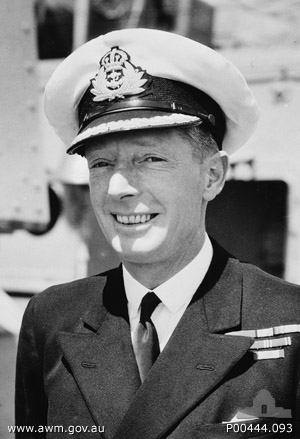
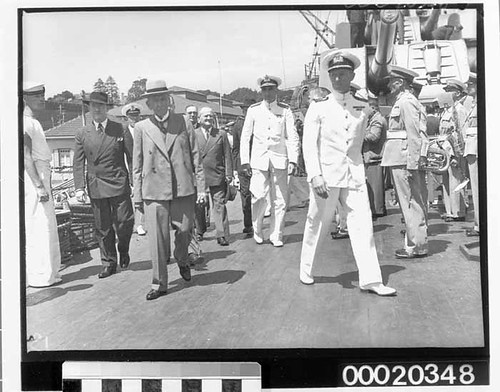
The Aussie Admiral, Sir John Augustine Collins, KBE, CB

Remembering Vice Admiral Sir John Augustus Collins, Royal Australian Navy.

Vice Admiral Sir John Augustine Collins KBE, CB (7 January 1899 – 3 September 1989) was a Royal Australian Navy (RAN) officer who served in World War I and World War II, and who eventually rose to become a Vice Admiral and Chief of Staff of the RAN.


Collins was one of the first graduates of the Royal Australian Naval College to attain flag rank. During World War II, he commanded the cruiser HMAS Sydney in the Mediterranean campaign. He led the Australian Naval Squadron in the Pacific theatre and was wounded in the first recorded kamikaze attack, in 1944.

World War II

Collins' career advanced steadily between the world wars. At the outbreak of war in 1939 he held the positions of Assistant Chief of Naval Staff and Director of Military Intelligence.

In the early war years, Collins commanded HMAS Sydney in the Battle of the Mediterranean. HMAS Sydney led Allied ships which sank a state-of-the-art Italian cruiser, Bartolomeo Colleoni, in July 1940. For this action he was appointed a Companion of the Bath (CB).

Captain Collins left the command of HMAS Sydney for other posts and the famous ship left for Western Australia under the command of Captain Burnett, with men and boys from every major city and town in Australia embarked. HMAS Sydney was to be sunk by the German raider Kormoran in the Indian Ocean. The sinking of HMAS Sydney remains to this day, Australia's most tragic loss at sea.


Relations between the RAN and British Royal Navy were close at the time, with frequent exchanges of officers between the two and in June 1941, Collins was transferred to Singapore, as Assistant Chief of Staff to the British Naval Commander in Chief, China Command, Vice Admiral Geoffrey Layton.

Following the outbreak of war with Japan, Collins was appointed Commodore Commanding China Force, the RN-RAN cruiser and destroyer force based in Batavia, Dutch East Indies, under the American-British-Dutch-Australian Command.


After the fall of Singapore and the Allied defeat in the Battle of the Java Sea, it became clear that the Dutch East Indies would be occupied by Japan. Collins organised the evacuation of Allied civilians and military personnel from Batavia, and was on one of the last ships to leave, before the city fell, in March 1942. As a result he was Mentioned in Despatches, and was later made a Commander of the Dutch Order of Orange-Nassau.

Collins was then appointed Senior Naval Officer, Western Australia, based at Fremantle.

During 1943, Collins commanded HMAS Shropshire and took part in the Bougainville campaign, the Battle of Cape Gloucester, and operations off the Admiralty Islands and Hollandia (Dutch New Guinea).
In mid-1944, Collins was made commander of the Australian-US Navy Task Force 74, and commander of the Australian Naval Squadron, with HMAS Australia as his flagship. He became the first graduate of the RAN College to command a naval squadron in action, during the bombardment of Noemfoor, on 2 July 1944.


Collins was badly wounded in the first kamikaze attack in history, which hit Australia on 21 October 1944, in the lead up to the Battle of Leyte Gulf. He did not resume his command until July 1945. When the war ended Collins was the RAN's representative at the surrender ceremony in Tokyo Bay.


Collins was appointed Chief of Naval Staff in 1948 and held the position until 1955. He was knighted as a Knight Commander of the Order of the British Empire (KBE) in the 1951 New Year Honours. He later served as Australia's High Commissioner to New Zealand (1956–1962).

The latest class of Australian submarine, the Collins class bears his name. The lead submarine, HMAS Collins, was launched by his widow on 28 August 1993. Collins Road, a street in the Sydney suburb of St Ives was also named in his honour.


Friday, 30 October 2009

Collision in Fog. This sinking of The Empress of Ireland.


RMS Empress of Ireland was an ocean liner built in 1905 by Fairfield Shipbuilding and Engineering at Govan on the Clyde in Scotland for Canadian Pacific Steamships (CP). This Empress was distinguished by the Royal Mail Ship (RMS) prefix in front of her name because the British government and Canadian Pacific Railway (CPR) had decades earlier reached agreement on a mail subsidy contract between Britain and Hong Kong via Canada.
While steaming on the Saint Lawrence River in fog, the Empress was struck amidships by the Norwegian collier (coal freighter) SS Storstad; and the fatally damaged vessel sank very quickly in the early morning of 29 May 1914. This accident claimed 1,024 lives, making it the worst maritime disaster in Canadian history.


Collision
The Empress of Ireland departed Quebec City for Liverpool at 16:30 local time on 28 May 1914 with 1,477 passengers and crew. Henry George Kendall had just been promoted to captain of the Empress at the beginning of the month; and it was his first trip down the Saint Lawrence River in command of the vessel.
Early the next morning on 29 May 1914, the ship was proceeding down the channel near Pointe-au-Père, Quebec (eastern district of the town of Rimouski) in heavy fog. At 02:00 local time, the Norwegian collier Storstad crashed into the side of the Empress of Ireland. The Storstad did not sink, but Empress of Ireland, with severe damage to her starboard side, listed rapidly, taking on water. Most of the passengers and crew in the lower decks drowned quickly when water poured into the ship from the open portholes, some of which were only a few feet above the water line. However, many passengers and crew in the upper deck cabins, awakened by the collision, made it out onto the boat deck and into some of the lifeboats which were being loaded immediately. Within a few minutes after the collision, the Empress of Ireland had listed so far on its starboard side that it became impossible to launch any more lifeboats than the four that had already been launched.

Ten or eleven minutes after the collision, the ship lurched violently on its starboard side in which as many as 700 passengers and crew crawled out of the portholes and decks onto its side. For a minute or two, the Empress of Ireland lay on its side, while it seemed to the passengers and crew that the ship had run aground. But a few minutes later, about 14 minutes after the collision, the ship's stern rose briefly out of the water, and its hull sank out of sight, throwing the hundreds of people still on its port side into the near-freezing water. Exactly 1,024 people died. Of that number, 840 were passengers, eight more than the Titanic.

There were only 465 survivors, four of whom were children (the other 134 children were lost) and 42 of whom were women (the other 279 women were lost). One of the survivors was the ship's commander, Captain Henry George Kendall, who was on the bridge at the time and quickly ordered the lifeboats to be launched. When the Empress was thrown on its side, Kendall was thrown from the bridge into the water, and was taken down with the ship as it began to go under. Swimming to the surface, Kendall clung to a wooden grating long enough for a nearby lifeboat, with crew members aboard, pulled him in. Immediately, Kendall took command of the lifeboat as well as rescue operations, as he had the lifeboat crew pull as many people from the water into the boat. When the boat was full, Kendall ordered the crewmen to row to the lights of the mysterious vessel that had rammed them to drop off the survivors. After an hour or two of making a few trips back and forth from the nearby Storstad to the wreckage to look for survivors, Kendall gave up when there was no more hope of finding survivors as most had succumbed to drowning or hypothermia.


Amongst the dead were the English dramatist and novelist Laurence Irving. Amongst the survivors, "Lucky" Tower is improbably said to have been one of the few crewmen who survived this shipwreck and the sinking of the Titanic and the sinking of the Lusitania.

The passengers included a large contingent of Canadian members of the Salvation Army. These travellers, all of whom died, were all members of the Canadian Salvation Army Band who were travelling to London for an international conference. At Mount Pleasant Cemetery in Toronto, Ontario, there is a monument reading "167 officers and soldiers of the Salvation Army promoted to glory" in the sinking.
Ultimately, the immense loss of life can be attributed to three factors: the location in which Storstad made contact, failure to close her watertight doors, and failure to close all portholes aboard. It was later revealed in testimony from surviving passengers and crew that nearly all of the portholes on the ship were left open by the passengers and crew who craved fresh air from the cramped and poorly ventilated staterooms. Under maritime rules, all portholes on travelling ships were to be closed, but this rule was frequently broken, especially in sheltered waters like the St. Lawrence river.

When the Empress began to its list to starboard, the water poured through the open portholes, flooding parts of the ship that were not damaged by the collision, and once that water hit nearly all the decks and compartments, the ship's end was inevitable.
The fact that most passengers at the time of the sinking were asleep, most not even awakened by the collision, also contributed to the loss of life when they were drowned in their cabins, most of them from the starboard side of the ship where the collision happened.


Saturday, 24 October 2009

Cut in Half. The sinking of HMS Punjabi


HMS Punjabi was a Tribal Class destroyer of the Royal Navy that saw service in the Second World War, being sunk in a collision with the battleship HMS King George V. She has been the only ship of the Royal Navy to bear the name Punjabi which in common with the other ships of the Tribal class, was named after an ethnic group of the British Empire. In this case, these were the Punjabi people, the inhabitants of the Punjab region between India and Pakistan.

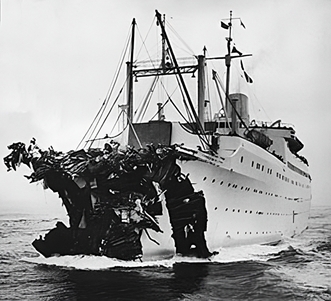
A picture of the mighty battleship HMS King George the 5th. Note the massive damage to her bows after slicing HMS Punjabi in half.


Punjabi was deployed on 26 April as part of the screen providing distant cover for the passage of Convoy PQ-15. They sailed from Hvalfjörður on 29 April. On 1 May she was rammed and sunk in a collision with HMS King George V in foggy conditions. Punjabi was sliced in two by the battleship's bow. 169 of the ship’s company were rescued from the forward section, and another 40 were picked up from the sea by other escorts, including HMS Marne. Those crew left in the after section, which sank very quickly, were killed when her depth charges were detonated. 49 of her crew lost their lives in the accident.

She sank directly in the path of the US battleship USS Washington, which had to sail between the halves of the sinking destroyer. Washington suffered slight damage from the detonation of the depth charges. HMS King George V had sustained serious damage to her bows and was forced to return to port for repairs.

Friday, 2 October 2009

COLLISION AT SEA! The Sinking of the Andrea Doria.


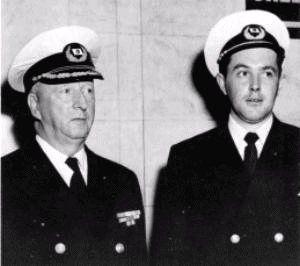
Captain of the Andrea Doria, Piero Calamai, 58, had been 40 years at sea and commanded his luxurious ship on 50 successful crossings of the Atlantic.


Captain Harry Gunnar Nordenson (left) with his third mate, Johan-Ernst Carstens-Johannsen. Nordenson was in his cabin when the young Carstens was in charge of the bridge at the moment of collision.


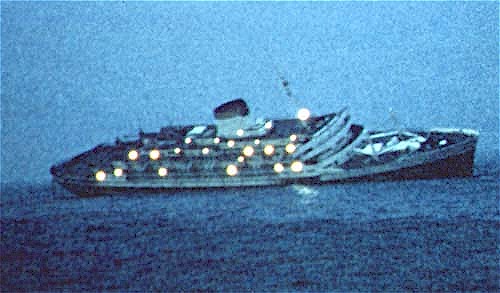
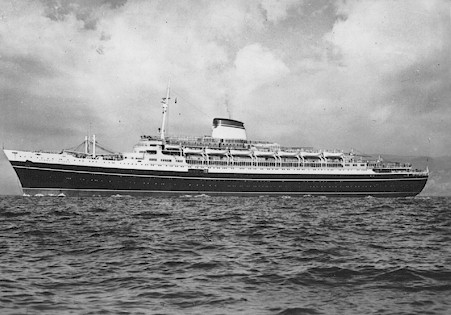
SS Andrea Doria was an ocean liner for the Italian Line (Società di navigazione Italia) home ported in Genoa, Italy, most famous for its sinking in 1956. Named after the 16th-century Genoese admiral Andrea Doria, the Andrea Doria had a gross register tonnage of 29,100 and a capacity of about 1,200 passengers and 500 crew. For a country attempting to rebuild its economy and reputation after World War II, Andrea Doria was an icon of Italian national pride. Of all Italy's ships at the time, Andrea Doria was the largest, fastest and supposedly safest. Launched on 16 June 1951, the ship undertook its maiden voyage on 14 January 1953.

On 25 July 1956, approaching the coast of Nantucket, Massachusetts bound for New York City, Andrea Doria collided with the eastward-bound MS Stockholm of the Swedish American Line in what became one of history's most famous maritime disasters. Struck in the side, Andrea Doria immediately started to list severely to starboard, which left half of her lifeboats unusable. The consequent shortage of lifeboats might have resulted in significant loss of life, but improvements in communications and rapid responses by other ships averted a disaster similar in scale to the Titanic disaster of 1912. 1660 passengers and crew were rescued and survived, while 46 people died as a consequence of the collision. The evacuated luxury liner capsized and sank the following morning.

The incident and its aftermath were heavily covered by the news media. While the rescue efforts were both successful and commendable, the cause of the collision and the loss of Andrea Doria afterward generated much interest in the media and many lawsuits. Largely because of an out-of-court settlement agreement between the two shipping companies during hearings immediately after the disaster, no determination of the cause(s) was ever formally published. Although greater blame appeared initially to fall on the Italian liner, more recent discoveries have indicated that a misreading of radar on the Swedish ship may have initiated the collision course, leading to some errors on both ships and resulting in disaster. However, the news that the crew had abandoned the passengers to their own fate dealt a marketing blow to the Italian Line it found hard to recover from.

Andrea Doria was the last major transatlantic passenger vessel to sink before aircraft became the preferred method of travel.


A collision course
On the evening of Wednesday, 25 July 1956, Andrea Doria, commanded by Captain Piero Calamai, carrying 1,134 passengers and 572 crew members, was heading west toward New York. It was the last night out of a transatlantic crossing from Genoa that began on 17 July. The ship was expected to dock in New York the next morning. At the same time, MS Stockholm, a smaller passenger liner of the Swedish American Line, had departed New York about midday, heading east across the North Atlantic Ocean toward Gothenburg, Sweden. Stockholm was commanded by Captain Harry Gunnar Nordenson, though Third Officer Johan-Ernst Carstens-Johannsen was in command on the bridge at the time. Stockholm was following its usual course east to Nantucket Lightship, making about 18 knots (33 km/h) with clear skies. Carstens estimated visibility at 6 nautical miles (11 km).
As Stockholm and Andrea Doria were approaching each other head-on, in the heavily-used shipping corridor, the westbound Andrea Doria had been traveling in heavy fog for hours. The captain had reduced speed slightly from 23.0 to 21.8 knots (42.6 to 40.4 km/h), activated the ship's fog-warning whistle, and had closed the watertight doors, all customary precautions while sailing in such conditions. However, the eastbound Stockholm had yet to enter what was apparently the edge of a fog bank and was apparently unaware of it. (The waters of the North Atlantic south of Nantucket Island are frequently the site of intermittent fog as the cold Labrador Current encounters the Gulf Stream.)

As the two ships approached each other, at a combined speed of 40 knots (74 km/h), each was aware of the presence of another ship but was guided only by radar; they apparently misinterpreted each others' courses. There was no radio communication between the two ships.

The original inquiry established that in the critical minutes before the collision, Andrea Doria gradually steered to port, attempting a starboard-to-starboard passing, while Stockholm turned about 20 degrees to its starboard, an action intended to widen the passing distance of a port-to-port passing. In fact, they were actually steering towards each other — narrowing, rather than widening, the passing distance. Compounded by the extremely thick fog that enveloped the Doria as the ships approached each other, the ships were quite close by the time visual contact had been established. By then, the crews realized that they were on a collision course, but despite last-minute manoeuvres, they were unable to avoid the collision.
In the last moments before impact, Stockholm turned hard to the starboard and was in the process of reversing its propellers attempting to stop. The Doria, remaining at its cruising speed of almost 22 knots (41 km/h) engaged in a hard turn to port, its Captain hoping to outrun the collision. At approximately 11:10 PM, the two ships collided.


Impact and penetration

When Andrea Doria and Stockholm collided at almost a 90-degree angle, Stockholm's sharply raked ice breaking prow pierced Andrea Doria's port side approximately midway of its length. It penetrated three passenger cabins, numbered 52, 54, and 56 to a depth of nearly 40 feet (12 m), and the keel. The collision smashed many occupied passenger cabins and, at the lower levels, ripped open several of Andrea Doria's watertight compartments. The gash pierced five fuel tanks on Andrea Doria's starboard side and filled them with 500 tons of seawater. Meanwhile, air was trapped in the empty tanks on the port side, contributing to a severe, uncorrectable list. The ship's large fuel tanks were mostly empty at the time of the collision, since the ship was nearing the end of its voyage.

Meanwhile, on the bridge of Stockholm, immediately after the impact, engines were placed at ALL STOP, and all watertight doors were closed. The ships were intertwined for about 30 seconds. As they separated, the smashed bow of the stationary Stockholm was dragged aft along the starboard side of the Doria, which was still moving forward, adding more gashes along the side. The two ships then separated, and the Doria moved away into the heavy fog. Initial radio distress calls were sent out by each ship, and in that manner, they learned each others' identities.

The world soon became aware that two large ocean liners had collided.

This was the SOS sent by Andrea Doria:

"SOS DE ICEH SOS HERE AT 0320 GMT LAT. 40.30 N 69.53 W NEED IMMEDIATE ASSISTANCE"

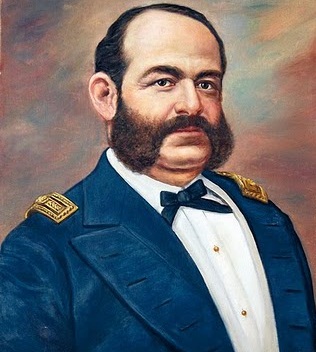
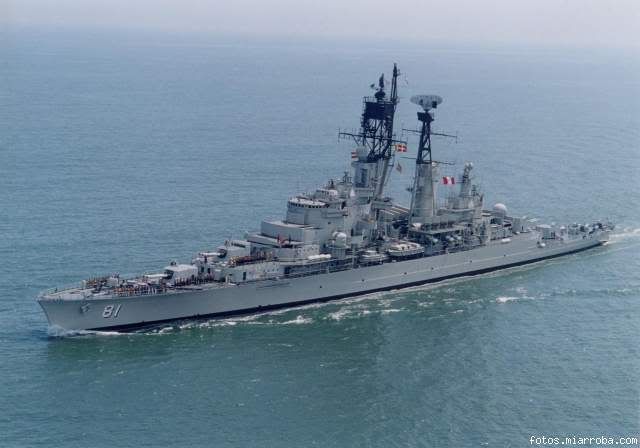
KNIGHT OF THE SEA, Admiral Miguel Grau Seminario of PERU and the Ironclad Huascar.


Miguel María Grau Seminario (b. Paita, Peru, 27 July 1834 - d. Punta Angamos, Bolivia, 8 October 1879) was a renowned Peruvian naval officer and hero of the Naval Battle of Angamos during the War of the Pacific (1879-1884). He was known as the el Caballero de los Mares (Spanish for "Knight of the Seas") for his chivalry and is esteemed by both Peruvians and Chileans.

He is an iconic figure for the Peruvian Navy, and one of the most famous military leaders of the Americas.

Miguel Grau was born in Paita on 27 July 1834 in the house of Dr. Alexander Diamont Newel with the assistance of the midwife Tadea Castillo, also known as "The Morito," both prominent figures in Paita. His father was Don Juan Manuel Grau y Berrío, a former lieutenant colonel in the Colombian army who came to Peru with Bolivar in the fight for independence from Spain. Later, Don Juan bought property in Paita and worked at the Customs Office. His mother, Luisa Seminario y del Castillo, motivated Grau to love the sea from his youth. He entered the Paita Nautical School. He first went to sea when he was nine years old, going to Fortune, Colombia, aboard a merchant schooner.

The the schooner sank and he returned to Paita. Grau later went on various merchant ships to ports in Oceania, Asia, America and Europe. These voyages gave Grau strong the seagoing experience for his brilliant career as a naval officer.
In 1853, at the age of 19, he left the merchant marine and became an officer candidate of the Peruvian Navy, where he developed an outstanding professional reputation. In 1854, he was Alferez de Fragata of the steamer Rimac. His career was rapid and brilliant. In 1863, he was promoted to Teniente 2• and to Teniente 1• a year later.


In 1864, he was sent to Europe to oversee the construction of ships for the Peruvian fleet. Among these ships was the ironclad Huáscar, launched in 1865 by Laird at Birkenhead. Upon his return, Chile and Peru joined together in a binational fleet against Spainish attempts to reclaim their American colonies. In 1865, he was promoted to Capitán de Fragata. He left the navy briefly to serve as a member of congress representing Paita. In 1868, he was recalled to the Navy and was named commander of the Huáscar with the rank of Capitán de Navio. In 1876 he was again elected a congressman for Paita.

War of the Pacific

When the War of the Pacific against Chile began on 5 April 1879, Miguel Grau was a Capitán de Navio in the Peruvian Navy, in command of the ironclad Huáscar. Capitán Grau played an important role by interdicting Chilean lines of communication and supply, damaging, capturing or destroying several enemy vessels, and bombarding port installations. Grau's Huáscar became famed for moving stealthily, striking by surprise and then disappearing. These actions put off a Chilean invasion by sea for six months and resulted in his promotion to the rank of Contra-Almirante (Rear Admiral).


The Knight of the Seas

At the Battle of Iquique, after Huáscar sank the chilean corvette Esmeralda, Grau ordered the rescue of the surviving crew from the waters. When landed, the chileans survivors shouted in recognition to Grau "¡Viva el Perú generoso!" ("Viva the generous Peru!"). Grau also wrote condolences to the widow of his opponent Arturo Prat, returning his sword and personal effects.

Letter to Carmela Carvajal de Prat (Prat's widow)

Dear Madam:
I have a sacred duty that authorizes me to write you, despite knowing that this letter will deepen your profound pain, by reminding you of recent battles.

During the naval combat that took place in the waters of Iquique, between the Chilean and Peruvian ships, on the 21st day of the last month, your worthy and valiant husband Captain Mr. Arturo Prat, Commander of the Esmeralda, was, like you would not ignore any longer, victim of his reckless valor in defense and glory of his country’s flag.

While sincerely deploring this unfortunate event and sharing your sorrow, I comply with the sad duty of sending you some of his belongings, invaluable for you, which I list at the end of this letter. Undoubtedly, they will serve of small consolation in the middle of your misfortune, and I have hurried in remitting them to you.

Reiterating my feelings of condolence, I take the opportunity of offering you my services, considerations and respects and I render myself at your disposal.


At the port of Antofagasta, after sneaking up on an enemy ship, he courteously asked the crew to abandon ship before opening fire. These and other gestures earned him the nickname of el Caballero de los Mares ("Knight of the Seas" or "Gentleman of the Seas") from his Chilean opponents, acknowledging an extraordinary sense of chivalry and his gentlemanly behaviour, combined with his highly-efficient and brave combat career.

Death at Battle of Angamos

Almirante Grau was killed by an armour-piercing shell during the Naval Battle of Angamos on 8 October 1879. Huáscar was captured by the Chileans after incurring severe casualties in the close-range artillery duel. Although most of Grau's body was not recovered, his remains were buried with military honours in Chile, which were returned to Peru in 1958. For many years after his death, his name was called in a ceremonial roll-call of the Peruvian Navy. He posthumously received the rank of Gran Almirante del Perú (Grand Admiral of Peru) in 1967 by order of the Peruvian Congress. A portrait of Almirante Grau is on
display in the museum ship Huáscar.

Legacy

In the year 2000, Miguel Grau was recognized as the "Peruvian of the Millennium" by popular vote.


Tuesday, 29 September 2009

Three Years Ago, TODAY. Remembering Michael Monsoor, United States Navy. Valour Unequalled.


Today is September 29th, the day three years ago when naval men across the world, and for all time, were made known of an act of courage barely without parallel.

Michael Monsoor died on this day three years ago; in late September, 2006.

"O Eternal Lord God, who alone spreadest out the heavens and rulest the raging of the sea; who has compassed the waters with bounds until day and night come to an end; be pleased to receive into thy Almighty and most gracious protection the persons of us thy servants, and the Fleet in which we serve. Preserve us from the dangers of the sea, and from the violence of the enemy, that we may be a safeguard unto our most gracious Sovereign Lady, Queen Elizabeth, and her Dominions, and a security for such as pass on the seas upon their lawful occasions; that the inhabitants of our Empire may in peace and quietness serve thee our God; and that we may return in safety to enjoy the blessings of the land, with the fruits of our labours, and with a thankful remembrance fo thy mercies to praise and glorify thy holy name, through Jesus Christ our Lord. Amen."


The Naval Prayer is offered by me, your unworthy correspondent, in memory of Master at Arms Michael Monsoor, United States Navy. The naval prayer, you will note, has at it's core, a devotion to the crown of England. This is meant as no disrespect.

On the contrary, The Royal Navy was the principal ruler of the seas for centuries, and though no longer the service of greatest strength upon the Oceans of our world, The Senior Service exists in perpetuity of that, it's greatest legacy; the strength, courage, selflessness and devotion of the men who go down to the sea in ships. Men like Navy SEAL Michael Monsoor.


MICHAEL ANTHONY MONSOOR
UNITED STATES NAVY

FOR VALOUR.

They that go down to the sea in ships and occupy their business in great waters: these men see the works of the Lord and his wonders in the deep. For at his word the stormy wind ariseth which lifteth up the waves thereof. They are carried up to the heaven, and down again to the deep: their souls melteth away because of the trouble. They reel to and fro, and stagger like a drunken man, and are at their wits' end. So when they cry unto the Lord in their trouble, he delivereth them out of their distress. For he maketh the storm to cease so that the waves thereof are still. Then are they glad because they are at rest; and so he bringeth them unto the haven where they would be.