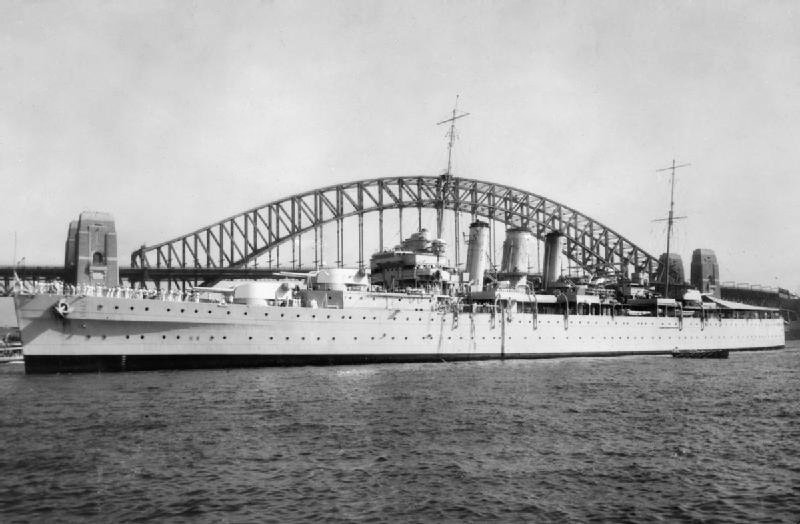
HMS Dorsetshire was a gorgeous ship. A County Class, three-stack heavy cruiser. She was fast, very fast, and packed a wallop. She could lift her ten tons to clip at 32.5 knots if so inclined, but she had no ASW equipment, or anti-submarine warfare. As you might imagine, this would play heavily on the mind of anyone charged with the responsibility of commanding her.
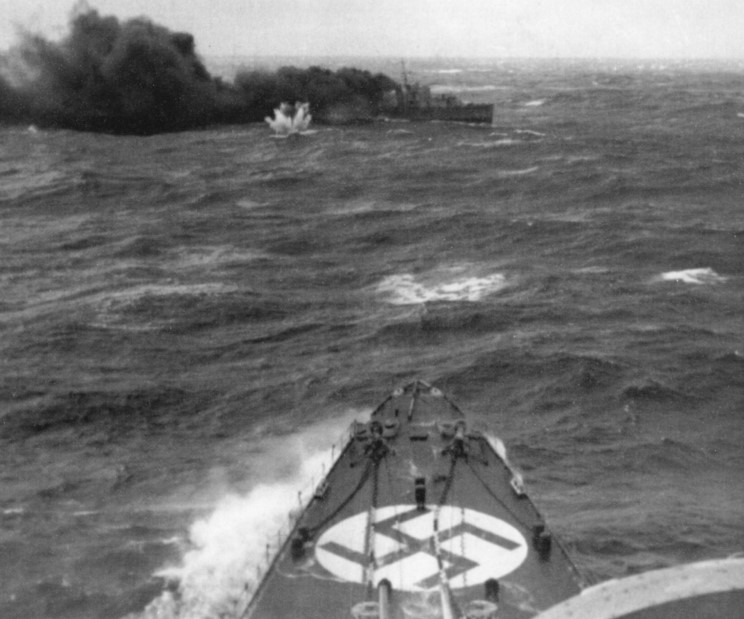
In late May 1941, the Dorsetshire was one of the ships which engaged the German battleship Bismarck in the North Atlantic. On 27 May, the Dorsetshire was ordered to torpedo the Bismarck, which had by that point been crippled by repeated aircraft and naval attacks. The Dorsetshire torpedoed the Bismarck, which then sank rapidly, either from the damage she had received from the British, or from the Bismarck's crew working to scuttle her. The Dorsetshire was able to recover only 110 of the Bismarck's crew from the ocean, before being forced to leave to evade a suspected U-boat.
So goes the official line.
Let's now take a closer look.
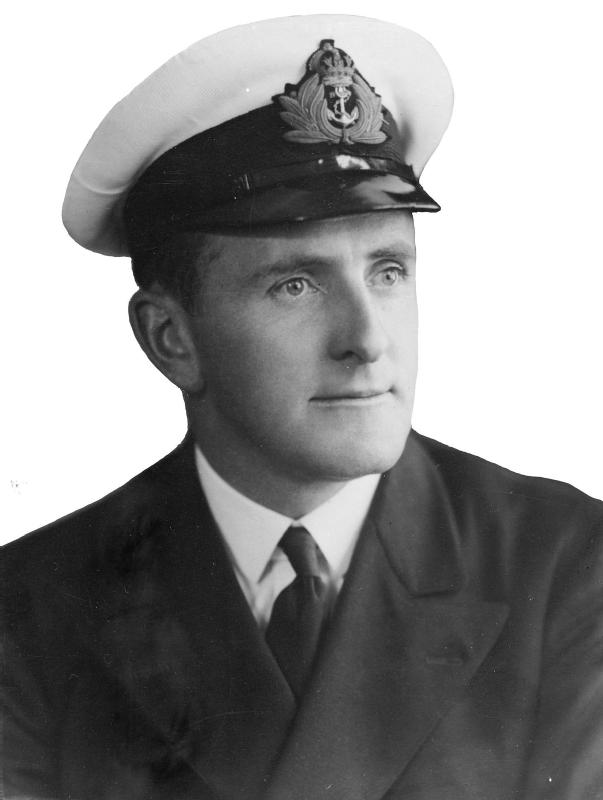
As with the Bismarck, it is important to develop a sense of the man who commanded this mighty British warship. His name was Benjamin Charles Stanley Martin, born July 18th, 1891.


Benjamin Martin was no stranger to the sea. He joined the Royal Navy as a boy sailor in 1907. He rose through the ranks of the lower deck, eventually rising to the rank of Warrant Officer, the highest non-commissioned rate in the Royal Navy. He saw action in the notorious Battle of Jutland during the first World War when serving in HMS Malaya. By the end of this infamous engagement, when Admirals Jellicoe and Sheer had their only direct head-to-head engagement, 24 ships would be on the bottom. 6000 British and 2500 German sailors would be dead.
Benjamin Martin knew a very great deal about battle at sea. He was there.
Much has been said about HMS Dorsetshire's failure to pick up more than the scant few of some 800 of Bismarck's survivors in the water after her sinking. I, too, for many years, found it unfathomable that he failed to do so. I believed he was a brutal man, so embittered by the sinking of HMS Hood that he used the pretext of a proximate submarine to abandon those men and boys, many still clinging to the ship's side. He steamed away and left them to die, one by one, in their hundreds.
Time plays tricks on the truth though. History merges with legend. Legend becomes myth, and in no time at all, the truth becomes obscured by the bullshit of opinion and diluted fact. I am as guilty as anyone in this regard and I now hold an entirely variant view of Captain Martin. I sincerely believe him to be a distinguished and highly experienced officer and warship commander who did the only feasible thing available to him at the time.
I have recently had the privilege of meeting a member of HMS Dorsetshire's ship's company. I cannot mention who, not because I think he would object to being mentioned here, but simply because I have not obtained his permission. To name him here without it would be quite improper, but suffice it to say, this sailor worked intimately with Captain Martin and knew him better than any other person onboard the ship.
Captain Martin was held in immensely high regard by the lower deck in HMS Dorsetshire. He was known, with tremendous affection, as "PINCHER" Martin and many of the survivors of her ultimate sinking would go on to offer the view that their ship would never have been sunk at all if "PINCHER" was still in command off Ceylon that Easter Sunday of 1942, rather than the show pony Augustus Agar, VC.
Martin was "stern when needed" and a "good humoured man" with a "strong sense of duty". According to my wonderful witness, Captain Martin was never further than shouting distance from his bridge when underway.
As to reports of brutality and suicides, it must be remembered that HMS Dorsetshire was based in Plymouth. As such she was, at that time, a Guz ship, in naval slang. 'Guz', or Plymouth, was repeatedly bombed during the war and suffered terrible destruction. There was rarely any news from home. No knowledge of whether loved ones, their children, were alive or dead. This played ferociously on the minds of all on board, but for two it became too much to bear. By May of 1941, HMS Dorsetshire had been away from home port for three years. She visited GUZ only once in all that time and then for only a month, permitting 2 weeks leave for each watch. Apart from this, there was no family contact, no mail, no news. The strain of it lead to two suicides under the Captain Martin's Command. One, a leading torpedoman, hanged himself and a junior gunnery officer shot himself. Both from abject despair at separation from those they loved.
As to the abandonment of those German men and boys in their hundreds.
An extract from 'Pursuit', by Ludovic Kennedy.
The Dorsetshire came round from the port side where she had fired her last torpedo, lay stopped in the sea a little way off; and survivors who had wondered if they were not escaping death by shellfire for death by drowning, felt a new surge of hope: even if it meant being taken prisoner, they were going to be rescued, they were going to live.
They struck out as well as they could towards the cruiser, though with the high seas and the oil from Bismarck's tanks and the wounds of many, it wasn't easy. Mullenheim-Rechberg, swimming along, passed a man who said, "I've no left leg any more". Staat remembered being told that when you died of cold, you first felt it in the testicles, but it was his feet and fingers that were getting numb. After more than an hour's swimming the first of them reached the Dorsetshire's side, where rafts, ropes, scrambling nets, fenders, lifelines of all kinds had been let down. Mullenheim-Rechberg noticed that many men, not seamen, didn't know how to grip a straight rope, urged them to get into ropes with bowlines. Staat's fingers were so frozen that he couldn't grip the rope at all, seized it with his teeth, was hauled on board that way. Mullenheim-Rechberg put his foot in a bowline rope, was pulled up by two sailors: when he reached deck level he tried to grab the guard-rail, was too exhausted and fell back into to sea. He got into the same rope again, was hauled up by the same two sailors, this time took no risks, said in immaculate English, "please help me on board", which they did. Midshipman Joe Brooks of the Dorsetshire went down one of the lifelines, tried to get a bowline round a German who had lost both arms and was gripping the lifeline with his teeth. The ship rolled heavily, they both went under. Brooks never saw him again.
The Dorsetshire had picked up some eighty men and the Maori some twenty, many more were in the process of being hauled up and hundreds more were waiting in the water when an unexpected thing happened. Dorsetshire's navigating officer, Lieutenant Commander Durant, sighted on the starboard bow two miles away a smoky discharge in the water. He pointed it out to Catpain Martin and others on the bridge. No one knew what it was but the most likely explanation was a U-boat. The Admiralty had sent a warning that U-boats were on the way and they were lucky not to have encountered any already. And if it was a U-boat, Dorsetshire, laying stopped in the water, was a sitting target. In the circumstances, Captain Martin had no choice but to ring down for full speed and in HMS Maori, Commander Armstrong did the same.
Bismarck survivors who were almost on board were bundled over the guard-rails on to the deck: those half-way up the ropes found themselves training astern, hung on as long as they could against the forward movement of the ship, dropped off one by one, others in the water clawed frantically at the paintwork as the side slipped by. In Dortsetshire they heard the thin cries of hundreds of Germans who had come within an inch of rescue, had believed that their long ordeal was at last over, cries that the British sailors, no less than survivors already on board, would always remember. From the water, Bismarck's men watched appalled as the cruiser's grey side swept past them, believed then that tales they'd heard about the British not caring much about survivors where true after all, presently found themselves alone in the sunshine on the empty, tossing sea. And during the day, as they floated about he Atlantic with only lifebelts between them and eternity, the cold came to their testicles and hands and feet and heads, and one by one they lost consciousness, and one by one they died.
My expert witness to these dreadful events, corroborates Kennedy's version of events. In fact it was he, my witness, who ran Captain Martin's order to the commander overseeing the rescue operation. Captain Martin further ordered denton rafts and anything that floated to be tossed overboard to provide whatever assistance he could. We should all remember that the principal responsibliity of ALL warship captains, is to his own ship and crew. A ten ton heavy cruiser, dead in the water, would have presented a tasty target indeed to a U-boat, none of whom knew the fate of Bismarck. They were racing to the scene to help her make Brest.
And now from the German point of view.
Baron Burkard von Müllenheim-Rechberg, refered to in the above extract from Ludovic Kennedy's book, was the senior ranking officer among the survivors of Bismarck, hauled aboard HMS Dorsetshire. I'm delighted to show you this.....

It is a note sent by Captain Martin to the German the day after his rescue.
von Müllenheim-Rechberg writes in his book 'Battleship Bismarck, a Survivor's Story'.....
Escorted by the first officer, Commander CW Byas, I went to see how our men were getting along. Everything was satisfactory; the ship's surgeon was taking care of the sick and injured, and they all felt they were being treated very well. They were getting five meals a day and eating the same excellent food as the crew. The smokers among them were being issued twenty cigarettes a day. I learned later that it was no different in the Maori, which picked up twenty-five men, bringing the number resuced by British ships to 110, about 5 per cent of the more than 2200 on board.
When Byas took me to the bridge, Captain Martin greeted me in a friendly enough manner and gave me a Scotch. The gesture was well meant but I was still too horrified at his leaving all those men in the water the day before to really appreciate it. "Why', I burst out, "did you suddently break off the rescue and leave hundreds of our men to drown?" Martin replied that a U-boat had been sighted, or at least reported, and he obviously could not endanger his ship by staying stopped any longer. The Bismarck's experiences on the night of 26 May and the morning of the 27th, I told him, indicated that there were no U-boats in the vicinity. Farther away, perhaps, but certianly not within firing range of the Dorsetshire. I added that in war one often sees what one expects to see. We argued the point back and forth until Martin said ubruptly: "Just leave that to me. I'm older than you are and have been at sea longer. I'm a better judge". What more could i say? He was the captain and was responsible for his ship.
Apparently, some floating object had been mistaken for a persiscope or a strip of foam on the water for the wake of a torpedo. No matter what it was, I am now convinced that, under the circumstances, Martin had to act as he did.
I would like to end by mentioinng Martin Smith, son of Allon Smith, observer on the Dorsetshire's Walrus. Martin has been a faithful correspondent here on this blog and has been equally faithful to the remembrances of his father. Martin Smith has written here that Allon Smith, Dorsetshire's observer aircrew member, thought of Captain Martin, "a proper bastard". I would like to wonder out loud that, if in the entire history of the fleet air arm, Mr. Smith is the only junior officer who though ill of his captain. For many, even today, it is de rigueur.
Finally, much has been written of Midshipman Brooks and his attempted rescue. My witness has reported that, whilst he was certainly reprimanded by Captain Martin, he was NOT confined to his cabin. I have, in my research, unearthed quite a bit of material about what became of Midshipman Brooks and will publish it in the days ahead.
In conclusion, I think Captain Martin has been inadequately remembered for his part in one of the great naval battles of history. His was an unenviable position on that late morning, sixty nine years ago today, but my research has revealed he was an honourable man, a brave and dutiful officer, first-rate warship captain, and a decent man possessed of a strong moral core and excellent qualities of leadership. His memory deserves to be dishonoured no longer.




 Liverpool, United Kingdom