A Military Cross has been awarded to 20 year old Able Seaman Kate Nesbitt of the Royal Navy.
A 20-year-old medic who repeatedly rushed forward to save colleagues while under attack from the Taleban has become the first woman in the Royal Navy to be awarded the Military Cross and only the second in the Armed Forces.
Able Seaman Class 1 Kate Nesbitt tended wounded colleagues from 3 Commando Brigade Royal Marines several times when they came under fire while on patrol in Afghanistan. The Ministry of Defence said: “Able Seaman Nesbitt’s actions throughout a series of offensive operations were exemplary. Under fire and under pressure her commitment and courage were inspirational and made the difference between life and death. She performed in the highest traditions of her service.”
The Military Cross is given to members of the Armed Forces “for exemplary gallantry during active operations against the enemy”, and ranks below only the Victoria Cross and Conspicuous Gallantry Cross as a recognition of bravery in battle.
Private Michelle Norris, 18, a medic with the Royal Army Medical Corps, was the first woman to win the Military Cross. She braved heavy sniper and machinegun fire from 200 insurgents during a fierce battle in southern Iraq in 2006. She climbed on top of an armoured vehicle to give life-saving treatment to a comrade.
Able Seaman Nesbitt’s award was one of more than 100 announced by the MoD yesterday in relation to 3 Commando Brigade’s tour of duty in Helmand between October and March. She was one of 14 to receive the Military Cross. Two were awarded to members of the special forces; their names were not published.
Bob Ainsworth, the Defence Secretary, said the servicemen and women recognised were the pride of Britain.
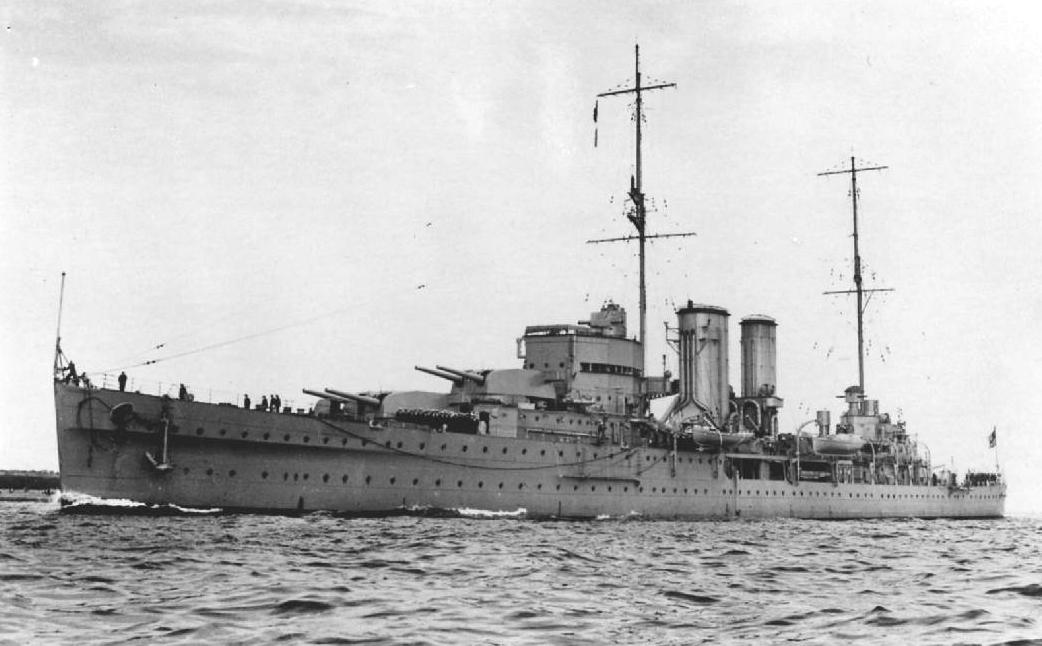
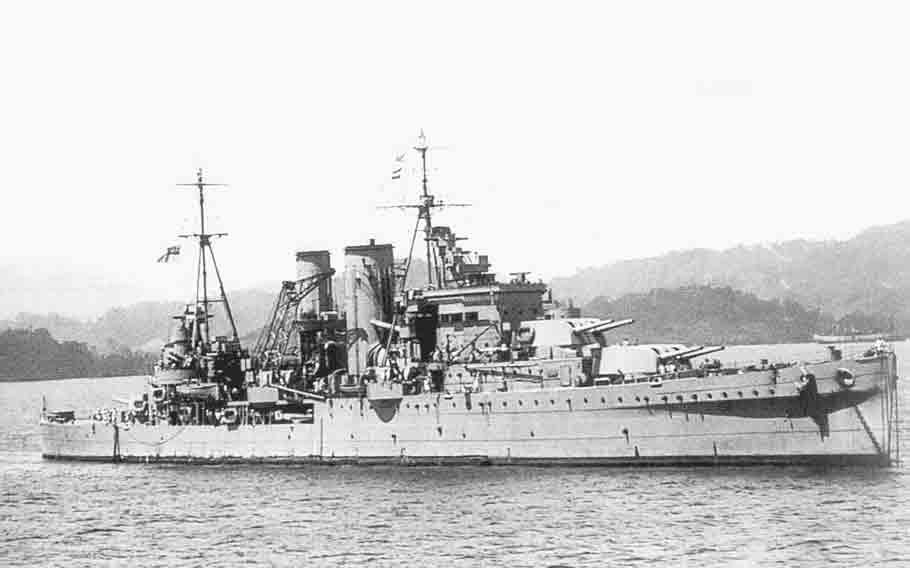
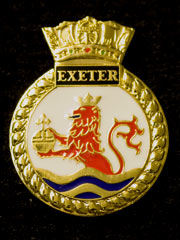
HMS Exeter (68) was a York class heavy cruiser of the Royal Navy that served in World War II. She was laid down on 1 August 1928 at the Devonport Dockyard, Plymouth, Devon. She was launched on 18 July 1929 and completed on 27 July 1931. She fought against the German pocket battleship Graf Spee at the 1939 Battle of the River Plate, suffering extensive damage that caused a long refit. Having been rebuilt, she was sent to the East Indies where she was sunk by the Japanese in 1942.
Exeter was ordered two years after her sister York and therefore her design incorporated improvements in the light of experience with the latter. Her beam was increased by 1-foot (30 cm) to cater for increases in topweight, and the boiler uptakes were trunked backwards from the boiler rooms, allowing for straight funnels removed from the bridge rather than the raked funnels necessary in York to ensure adequate dispersal of the flue gasses. As a result, the masts were stepped straight, and the after funnel was thickened, to aid appearance. As the roof of the 8-inch (203 mm) gun turret had proved to be inadequately strong to accommodate the catapult intended for York, Exeter had a pair of catapults angled out from amidships, with the associated crane stepped to starboard. Consequently, the bridge could be lowered (that of York being tall to give command over the intended aircraft arrangements), and was of a modern, enclosed design that was incorporated into later cruiser designs.
Modifications
In 1932, Exeter had side plating added amidships to the upper deck to enclose her open main deck as far as the after funnel (unlike the County class, the Yorks were not flush-deckers). This provided additional enclosed spaces for accommodation and working. In 1935, the intended multiple Vickers machine guns were finally added, single QF 2-pounder guns having been fitted in lieu. Early war modifications saw the replacement of the single 4-inch (102 mm) guns with modern twin Mark XVI models on the ubiquitous mounting Mark XIX and a single 20 mm Oerlikon gun added to the roof of both 'B' and 'X' turrets. Radar Type 286 air warning was added requiring the pole masts to be replaced by tripods, this primitive metric set had separate transmitting (Tx) and receiving (Rx) aerials, one at each masthead. Radar Type 284 was fitted to the director control tower atop the bridge to provide ranging information and spot fall of shot.
Service
On completion, Exeter joined the 2nd Cruiser Squadron with the Atlantic Fleet, where she served between 1931 and 1935. In 1934 she was assigned to the America and West Indies Station and remained there, with a temporary deployment to the Mediterranean during the Abyssinian crisis of 1935 and 1936, until 1939.
At the outbreak of the Second World War, she formed part of the South American Division with Cumberland. Together with the Leander class light cruisers Ajax and Achilles she engaged the German pocket battleship Admiral Graf Spee in the Battle of the River Plate on 13 December 1939, which culminated in the scuttling of the Admiral Graf Spee several days later. Exeter operated as a division on her own, Achilles and Ajax as the other, in order to split the fire of Graf Spee. Exeter was hit by seven 11-inch shells and several near misses caused significant splinter damage. Sixty-one of her crew were killed and another twenty-three wounded. All three 8 inch turrets were put out of action and her speed was reduced to 18 knots (33 km/h), forcing her to withdraw from battle.
Exeter made for Port Stanley in the Falkland Islands for emergency repairs which took until January 1940, then returned to Devonport without assistance for full repairs between February 1940 and March 1941. On 10 March, 1941, during the repair and refit period, her commanding officer, Captain W.N.T. Beckett MVO DSC died at Saltash Hospital, from complications resulting from surgery related to injuries received earlier in his career. He died the day Exeter was due to be re-commissioned. His replacement was Captain Oliver Loudon Gordon.
On returning to the fleet in 1941 she was engaged on escort duty for Atlantic convoys, including the escort of convoy WS-8B to the Middle East during the Bismarck episode. After this, she went on to the Far East. On the entry of the Empire of Japan into the war in December 1941, Exeter formed part of the ABDACOM naval force intended to defend the Dutch East Indies (Indonesia) from Japanese invasion.
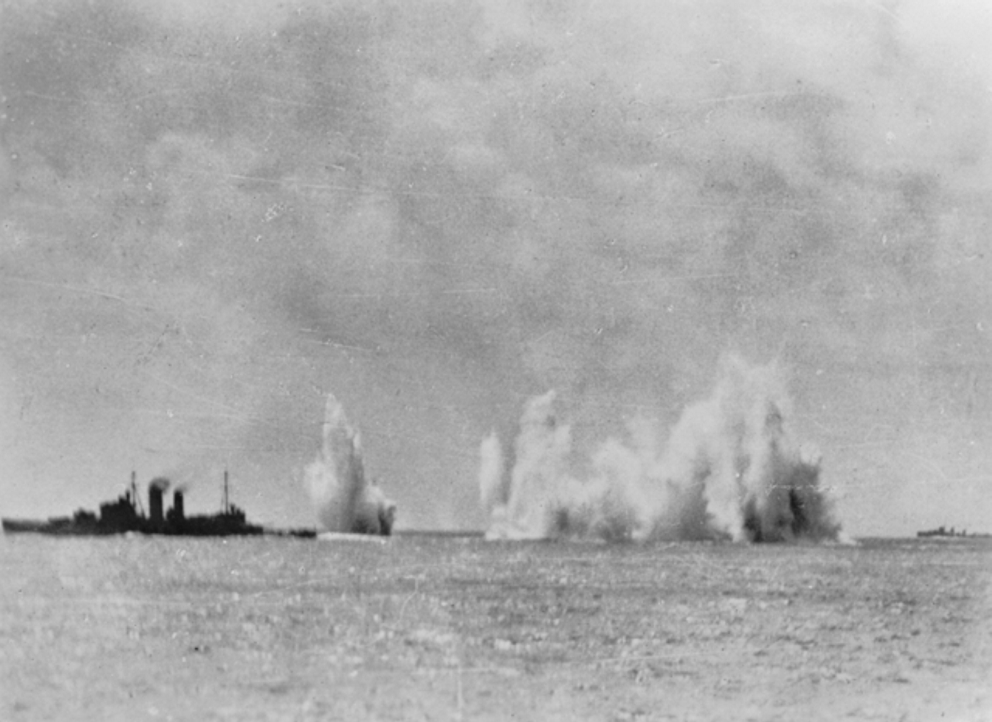
Exeter under attack in the First Battle of the Java Sea.
Fate
On 27 February 1942, Exeter was damaged in the Battle of the Java Sea when she received an 8-inch shell hit to a boiler room and was subsequently ordered to Surabaya for repairs. The destroyer HMS Electra was sunk covering her withdrawal. Two days later, when she attempted to reach the Sunda Strait, she was intercepted by the Japanese heavy cruisers Nachi, Haguro, Myoko and Ashigara and the destroyers Akebono, Ikazuchi, Inazuma, Yamakaze and Kawakaze on the morning of 1 March 1942.
The Second Battle of the Java Sea ensued, now more appropriately called The Battle of Bawean Island, and Exeter was soon badly damaged by gunfire, one hit causing the loss of all power to the ship. Scuttling charges were set and she soon began sinking, initially listing to port only to be hit to starboard by a torpedo from the destroyer Inazuma which sat her back upright and rolled her to starboard before she finally sank about noon. Her escorting destroyers, HMS Encounter and USS Pope were also lost; Pope temporarily escaped the initial melee, only to be sunk by aerial attack a few hours later. About 800 Allied seamen, including the commander of Exeter, Captain Oliver Gordon, were picked up by the Japanese and became prisoners of war.
The wreck was located and positively identified in February 2007. Exeter lies in Indonesian waters, at a depth of about 200 ft (60 m), 90 miles north of Bawean Island - some 60 miles from the sinking position given by her captain.
Rear-Admiral Sir David Haslam, who has died aged 86, was for 10 years Hydrographer of the Navy, responsible for the charts and nautical publications used by the Royal Navy, Merchant Navy and others worldwide.
As "Droggy", he commanded a fleet of a dozen survey ships while supervising, from his headquarters at Taunton, a staff of more than 1,000 civilians and retired hydrographers. These drew on the most recent information from the sea as well as an archive dating back to Captain Cook, maintaining 4,200 charts and 150 publications which are distributed by agents in 130 countries.
In Haslam's first few years chart sales earned some £3,300,000 and books a further £600,000, winning his office the Queen's Award for Export Achievement – a unique honour for a government department. But his success encouraged accountants to turn the Hydrographic Office into a self-funding, revenue-earning department which, unlike those of other navies, guarded its copyright jealously. As demand grew for ever more charts for yachtsmen and deeper draft ships, Haslam found himself fighting what were to become increasing demands for privatisation.
David William Haslam was born at Derby on June 26 1923 and educated at Bromsgrove School. He joined the Navy as a special entry in 1941 and spent two terms at Dartmouth before training at sea as a midshipman in the cruiser Birmingham, and the destroyers Quickmatch and Vivien. During Operation Ironclad, the British occupation of Madagascar, he was local control officer of a battery of three six-inch guns in the battleship Resolution.
Specialising in hydrography in 1944, he sounded the unexplored estuaries of Burma and Malaya from the survey ship White Bear (formerly Sir Thomas Lipton's steam yacht Iolanda) in preparation for the aborted Zipper landings. When consulted 50 years later by the Burmese government about deep-water routes for tankers, he said that the charts which bore his signature were still the most up-to-date available, but cautioned that he had produced them for shallow-draft landing craft using a leadline at night behind Japanese lines.
In 1946 Haslam surveyed other routes in the South China Sea to ensure they were obstruction-free, and a year later commanded Survey Launch 325 in locating wartime wrecks in the North Sea for clearance by explosives. Over the next 30 years he served in or commanded the survey ships Scott, Dalrymple, Dampier, Vidal, Owen, Hecla, Hydra and the Australian Tallarook in the Great Barrier Reef, the Indian Ocean, the West Indies as well as the Pacific and North Atlantic. Often he spent weeks in small boats away from his parent ship and sleeping under canvas on shore.
His work was not without incident. In 1957 he was responsible for security at the meeting between Harold Macmillan and President Eisenhower on Bermuda. While commanding Owen seven years later he found evidence on the sea floor for the theory of continental drift. In 1964 he evacuated women and children from Zanzibar after a coup. In command of Hecla in 1969, he landed a party which hoisted the Union flag over Rockall to reinforce Britain's claim to the island and its surrounding seas.
Five years later he was awarded the Royal Geographical Society's medal for finding shorter sea routes through the previously uncharted seas off the Solomon Islands. He also discovered a series of coral pinnacles in the Persian Gulf, known as Haslam's Patches, and an underwater mountain north-west of the Seychelles, Haslam Seamount.
He was loaned to the Royal Australian Navy from 1947 to 1949, and returned 18 years later as its hydrographer to draw, print and collect more than 300 charts as well as to represent Australia at the International Hydrographic Conference in 1967. After retiring as Hydrographer of the Navy in 1985 Haslam was, for five years, president of the directing committee of the International Hydrographic Office based in Monaco. He was president of the English Schools Basketball Association, president of Derbyshire County Cricket Club and chairman of the international committee of the Royal Institution of Chartered Surveyors.
Although he never married, he had numerous nephews and nieces as well as 32 godchildren. He was devoted to Bromsgrove School, serving as chairman of governors from 1991 to 1996. Recently he took the salute at the CCF passing-out parade, a ceremony in which he had participated more than 70 years earlier.
As an admiral Haslam eschewed the trappings of high office, rejecting his official car to be driven to functions by his PA in her purple Mini or to travel second-class by train, when he might meet sailors and discover their concerns. He was an inveterate pipe smoker who always seemed to run out of tobacco at the start of any official visit, and his flag lieutenant was well advised to have acquired a tin of Three Nuns beforehand to forestall the inevitable crisis.
David Haslam was appointed OBE in 1964, CB in 1979 and KBE in 1984. He died on August 4 with his pipe in hand while watching sport on television.
By any measure, the Japanese Battleship YAMATO is a beautiful creation of man's dreadful hand. Created in war, meant for one purpose and one purpose alone; the sinking of enemy combatants and the killing of the enemy's men.
Yamato (大和), named after the ancient Japanese Yamato Province, was a battleship of the Imperial Japanese Navy during World War II.
Flagship of the Japanese Combined Fleet, she was lead ship of the Yamato class. She and her sister ship, Musashi, were the largest and heaviest battleships ever constructed, displacing 72,800 tonnes at full load, and armed with nine 46 cm (18.1 inch) main guns.
Constructed from 1937 – 1940 and formally commissioned in late 1941, Yamato served as the flagship of Admiral Isoroku Yamamoto throughout 1942, first sailing as part of the Combined Fleet during the Battle of Midway in June 1942. Throughout 1943, Yamato continually transferred between Truk, Kure and Brunei in response to American airstrikes on Japanese island bases. The only time Yamato fired her main guns at enemy targets was in October 1944, but was ordered to turn back after attacks by destroyers and aircraft of the "Taffy" light escort carrier task groups managed to sink three heavy cruisers during the Battle off Samar. Yamato was sunk in April 1945 during Operation Ten-Go.
Yamato was the lead ship of the Yamato class of heavy-battleships, designed by the Imperial Japanese Navy in 1937. The class of battleship was designed to be capable of engaging multiple enemy targets, as a method of compensating for Japan's incapability to industrially compete with the United States Navy.
With the vessels of the Yamato class displacing over 70,000 tons each, it was hoped that the firepower of the constructed battleships could offset American industrial power. The keel of Yamato was laid down at Kure Naval Arsenal on 4 November 1937, in a specially designed dockyard. Throughout construction, large canvases prevented observation of the construction from elsewhere in the Kure Dockyards. Due to the size of the vessel, upgraded gantry cranes—each capable of lifting 150 and 350 tonnes—had to be designed and built for use during construction.
Yamato was launched 8 August 1940, with Captain (later Vice Admiral) Miyazato Shutoku in command.
Armament
Yamato's main battery consisted of nine 18.1-inch 40 cm/45 Type 94 naval guns—the largest caliber of naval artillery ever fitted to a warship. Each gun was 21.13 metres (69.3 ft) long, weighed 147.3 metric tons (162.4 short tons), and was capable of firing high-explosive or armour-piercing shells 42.0 kilometres (26.1 mi).
Her secondary battery comprised twelve 6.1-inch (15 cm) guns mounted in four triple turrets (one forward, one aft, two midships), and twelve 5-inch (13 cm) guns in six double-turrets (three on each side amidships). In addition, Yamato carried twenty-four 1-inch (2.5 cm) anti-aircraft guns, primarily mounted amidships. When refitted in 1944, the secondary battery configuration was changed to six 6.1-inch (15 cm) guns, twenty-four 5-inch (13 cm) guns, and one hundred sixty-two 1-inch (2.5 cm) antiaircraft guns, in preparation for naval engagements in the South Pacific.
Yamato's magazines finally explode, sending the mighty Battleship to the bottom.
1944: Combat
On 16 January 1944, Yamato arrived at Kure for repairs, and was drydocked until 3 February 1944. While drydocked, Captain Nobuei Morishita—former Captain of the battleship Haruna—assumed command of Yamato. On 25 February, both Yamato and Musashi were reassigned from the 1st Battleship Division to the Second Fleet. Yamato was again drydocked for upgrades to her radar and antiaircraft systems throughout March 1944, with a final AA suite of one hundred sixty-two 1-inch (25 mm) antiaircraft guns and twenty-four 5-inch (13 cm) medium guns. The radar suite was also upgraded to include infrared identification systems, aircraft-search and gunnery-control radar systems.
Following a short transport mission to the South Pacific in April, Yamato departed for Lingga alongside Jisaburo Ozawa's Mobile Fleet. In early June 1944, Yamato and Musashi departed as troop transports for Biak, with the intention of reinforcing both the garrison and naval defenses of the island. When word reached Ozawa's headquarters of American carrier attacks on the Mariana Islands, the mission was aborted.
From 19–23 June 1944, Yamato escorted forces of Ozawa's Mobile Fleet during the Battle of the Philippine Sea, dubbed by American pilots as "The Great Marianas Turkey Shoot". Japanese aircraft losses exceeded 400, while three aircraft carriers were lost to submarines and airstrikes. Yamato's only major engagement throughout the operation was mistakenly opening fire on returning Japanese aircraft. Following the battle, Yamato and the Mobile Fleet withdrew to Brunei to refuel and rearm.
Yamato hit by a bomb on 24 October 1944 during the Battle of the Sibuyan Sea; this hit did little damage, however.
From 22–25 October 1944, Yamato joined Admiral Takeo Kurita's Centre force in the Battle of Leyte Gulf, the largest naval engagement in history. While en route, the force was attacked in Palawan Passage by the submarines USS Darter and Dace. With torpedoes, they sank Maya and Atago (Kurita's flagship), and damaged Takao. This forced Kurita to transfer his flag to Yamato. During the Battle of the Sibuyan Sea, Yamato was hit with three armour-piercing bombs from aircraft of the USS Essex. Her sister-ship Musashi sank after being hit with seventeen torpedoes and nineteen bombs. On the evening of 24 October, Kurita's Centre Force navigated the San Bernardino Strait, attacking a small force of escort carriers and destroyers shortly after dawn.
In the initial stages of the Battle off Samar, Yamato engaged enemy surface forces for the first and last time, confirming hits on an escort carrier, a destroyer, and a destroyer escort. After confirming primary battery hits on USS Gambier Bay, a spread of American torpedoes heading for Yamato were spotted; the battleship was forced to withdraw from the fighting, and was unable to rejoin the battle. The task force disengaged later after three heavy cruisers were sunk, and the entire force was only able to sink one escort carrier and three destroyers.
Following the engagement off Samar, Yamato and the remainder of Force A returned to Brunei. On 15 November 1944, the 1st Battleship Division was disbanded, and Yamato became the flagship of the Second Fleet. On 21 November, while transiting the East China Sea in a withdrawal to Kure Naval Base, Yamato's battlegroup was attacked by the submarine USS Sealion, with the battleship Kongo and several destroyers lost. Upon returning to Kure, Yamato was immediately drydocked for repairs and antiaircraft upgrades, with several older antiaircraft guns being replaced. On 25 November, Captain Aruga Kosaku was named commander of Yamato.
Please click here for a most atmospheric rendering of the story yet to unfold.
With the sinking of the Bismarck in the Atlantic, the strategic value of the once almighty naval battleship was called into question. With the sinking of the Yamato, the fate of this class of ship was sealed, and so too the previously unquestioned precepts of naval warfare. From Nelson to the Yamato, the ensign had been stretched to breaking point. New thinking was urgently needed. It came from the air.
1945: Final operations and sinking
On 1 January 1945, Yamato, Haruna and Nagato were all transferred to the newly reactivated 1st Battleship Division; Yamato left drydock two days later. When the 1st Battleship Division was deactivated once again on 10 February, Yamato was reassigned to the 1st Carrier Division. On 19 March 1945 Yamato came under heavy attack when American carrier aircraft from Enterprise, Yorktown and Intrepid raided the major naval base of Kure where she was docked. Damage to the battleship, however, was light, due in part to the base being defended by elite veteran Japanese fighter instructors flying Kawanishi N1K "Shiden" or "George" fighters
Led by the man who planned the attack on Pearl Harbor, Minoru Genda, the appearance of these fighters, which were equal or superior to the F6F Hellcat in performance, surprised the attackers, and several American planes were shot down. Heavy antiaircraft defensive fire and the heavy upper-deck armour plating on Yamato also prevented any significant damage to the vessel. On 29 March, Yamato took on a full stock of ammunition, in preparation for combat off Okinawa in Operation Ten-Go.
Operation Ten-Go was a deliberate suicide attack against American forces off Okinawa by Yamato and nine escorts, beginning on 6 April 1945. Embarking from Kure, Yamato was to beach herself near Okinawa, and act as an unsinkable gun-emplacement—bombarding American forces on Okinawa with her 18.1-inch heavy-guns.
Yamato carried only enough fuel to reach Okinawa, as the fuel stocks available were insufficient to provide enough fuel to reach Okinawa and return. While navigating the Bungo Strait, Yamato and her escorts were spotted by the American submarines Threadfin and Hackleback, both of which notified Task Force 58 of Yamato's position. At 12:32 on 7 April 1945, Yamato was attacked by a first wave of 280 aircraft from Task Force 58, taking three hits (two bombs, one torpedo).
By 14:00, two of Yamato's escorts had been sunk. Shortly afterward, a second strike of 100 aircraft attacked Yamato and her remaining escorts. At 14:23, having taken 10 torpedo and 7 bomb hits, Yamato's forward ammunition magazines detonated. The smoke from the explosion—over 4 miles (6.4 km) high—was seen 100 miles (160 km) away on Kyūshū. An estimated 2,498 of the 2,700 crew members on Yamato were lost, including Vice-Admiral Seiichi Itō, the fleet commander.
The SS Armenian was built by Harland and Wolff in Belfast in 1895 and served with the Leyland Line until 1903. She spend a year chartered by the White Star Line and finished her life as a freighter. She was sunk by German Submarine of the Cornish coast in June of 1914
In June 1915, the SS Armenian, a large steamship managed by the White Star Line, the owners of the Titanic, heads into the Bristol Channel from the United States. She is carrying over 1400 mules destined for the Western Front. As the unarmed vessel nears the British coast, a German submarine spots the former liner and fires warning shots. To avoid capture, the Armenian makes a run for it. As the U-boat continually pounds her with shells, the captain orders the crew to abandon ship.
Once the remaining crew is safely off in lifeboats, the German U-boat fires a torpedo into the stern of the steamship. It only takes minutes for the Armenian to sink to the bottom of the Atlantic, with her unfortunate cargo of 1400 mules still on board. 29 American crewmembers also die, causing controversy as the United States have not yet officially entered the war.
More than 90 years later, the infamous White Star Line vessel has still not been found. Many have searched the waters off the coast of Cornwall, but the Armenian has proved to be elusive. Now, a new expedition of international divers is hunting for the ship known as the Bone Wreck. Using state-of-the-art dive and survey equipment, the team aims to be the first to find this long-lost vessel.
Underwater surveys have revealed several possibilities, and the divers’ first objective is to go down to two large wrecks near the point the captain of the Armenian noted as the location where he believed the ship went down. But even though one of those wrecks is full of bones, neither proves to be the Armenian. The expedition is forced to follow other lines of enquiry in order to locate the missing ship.
Unexpectedly, German archives reveal the actual log from the German U-boat that sank the mule transport. The German commander’s coordinates are at least 20 miles from where the ship was reported to have sunk and where the team has been searching. The final resting place of the Armenian has been found, with her sad cargo of thousands of mule bones aboard.
HMS Audacious was a King George V-class battleship of the Royal Navy. The vessel did not survive its first conflict, being sunk by a naval mine off the northern coast of Donegal in Ireland in 1914.
At the beginning of World War I Audacious was part of the Second Battle Squadron of the British Grand Fleet. On 27 October 1914 the Second Battle Squadron, consisting of the 'super-dreadnoughts' HMS King George V, HMS Ajax, HMS Centurion, Audacious, HMS Monarch, HMS Thunderer and HMS Orion, left Lough Swilly to conduct gunnery exercises at Loch na Keal.
In a middle of a turn at 08:05 Audacious ran upon a mine laid by the German auxiliary mine-layer Berlin. The port engine room was flooded immediately, and Audacious began to list heavily and settle by the stern. Captain Cecil F. Dampier, thinking that the ship had been attacked by a submarine, hoisted the submarine warning and the rest of the squadorn steamed away from possible danger. Audacious, though unmanageable, was still capable of making 9 knots (17 km/h) on her starboard engine. Dampier believed that he had a chance of making the 25 miles (40 km) to land and beach the ship.
The light cruiser Liverpool stood by, while Audacious broadcast distress signals by wireless. The Commander-in-Chief of the Grand Fleet, Sir John Jellicoe ordered every available destroyer and tug out to assist, but did not dare send out battleships to tow Audacious in because of the apparent submarine threat. Meanwhile the White Star liner Olympic arrived on the scene.
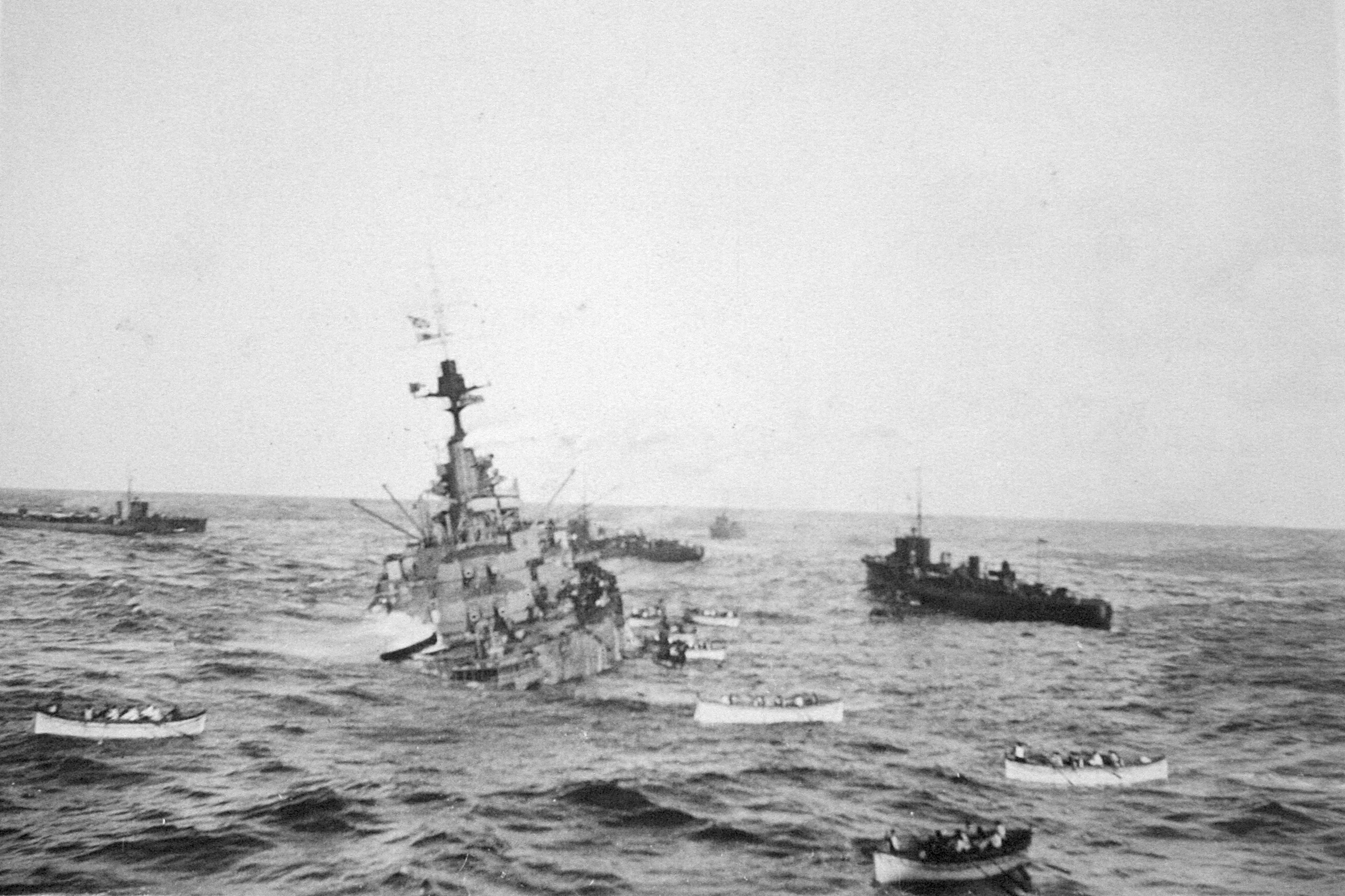
At 10:50, with flooding worsening in the starboard engine room, Audacious stopped. Dampier brought the head of the ship round to sea and ordered all non-essential crew off. Boats from Liverpool and Olympic assisted until all but 250 men were taken off. At 13:30 the captain of Olympic, Commodore Haddock, suggested that his ship attempt to take Audacious in tow. Dampier agreed and with the assistance of the destroyer Fury a tow line was passed within half an hour. The ships began moving toward Lough Swilly, but Audacious was so unmanageable that the tow line parted. Liverpool and the collier Thornhill attempted to take the battleship in tow, but to no avail. In the mean time, at 13:08 a message had arrived from the coastguard station at Mulroy that the steamer Manchester Commerce had been mined in the same area the day before.
At 16:60 Malin Head reported that the sailing vessel Cardiff had also been mined the previous night. Upon learning this, at 17:00 Jellicoe ordered the pre-dreadnought battleship Exmouth out to attempt to tow Audacious in. In case the ship was saved he also requested an officer from the Construction Department at the Admiralty in anticipation of major repairs.
Vice-Admiral Sir Lewis Bayly, commander of the First Battle Squadron, arrived on the scene in the boarding vessel Cambria and took over the rescue operation. With dark approaching, Bayly, Dampier and the remaining men on Audacious were taken off at 19:15. At 21:00 Audacious capsized and exploded, sending débris into the air. A piece of armour plate fell on and killed a petty officer on Liverpool, which was 800 yards (730 m) distant. This was the only casualty in connection with the sinking.
Jellicoe immediately proposed that the sinking be kept a secret, which the Board of Admiralty and the British Cabinet agreed to, an act open to ridicule later on. For the rest of the war Audacious' name remained on all public lists of ship movements and activities. Many Americans on board Olympic were beyond British jurisdiction and discussed the sinking. Many photos had been taken and even one moving film. By 19 November the loss of the ship was accepted in Germany. Jellicoe's opposing number in Germany, Reinhard Scheer, wrote after the war: "In the case of the Audacious we can but approve the English attitude of not revealing a weakness to the enemy, because accurate information about the other side's strength has a decisive effect on the decisions taken.



-21-07-2003]rear.gif)
-13-04-2005%5Dhmtg_logo.jpg&w=177&tran=1)